Tuesday, 27 March 2012

New Source Performance Standards: The Start of U.S. Climate Change Regulation?

Back in 2007, the United States Supreme Court ruled that greenhouse gases like carbon dioxide are air pollutants covered by the Clean Air Act.  That ruling gave the U.S. Environmental Protection Agency (EPA) the authority to issue an "endangerment finding" if the agency determined that greenhouse gases are a threat to public health and the environment.

This was a particularly tricky issue, because the health and environmental impacts from increased greenhouse gas concentrations are indirect, as opposed to pollutants like ozone, which directly harm living organisms or sulfur dioxide, which acidifies lakes and streams.  Nevertheless, in 2009 the EPA issued just such an "endangerment finding", opening the door for direct regulation should Congress fail to pass legislation reducing greenhouse gas emissions.

Now, five years after the original Supreme Court ruling, the EPA is finally preparing to exercise its authority to regulate emissions from power plants.  The agency is expected today to issue New Source Performance Standards that limit carbon dioxide emissions from newly constructed power stations to 1,000 pounds per megawatt-hour of generation.  For those more accustomed to metric units, that's about 0.45 tonnes CO2/MWh. A combined cycle natural gas power station can have emissions below 0.40 tonnes CO2/MWh and so is not likely to be affected by this regulation.

Other fossil fuels will face greater challenges.  If the rule stands, it means no new traditional coal-fired power plants will be built in the United States.  A typical coal-fired power station releases can release 0.90 tonnes CO2/MWh, or more.  To operate within the New Source Performance Standards, such a plant would have to generate half its power with renewable biomass fuels (physically possible for no more than a handful of power stations).  Otherwise they would need to employ carbon capture and storage (CCS) - a technology that may yet take decades to beome commercially viable - to bury the CO2 deep underground.

The EPA's New Source Performance Standards would grandfather existing power stations, and allow them to keep operating and undergo  retrofitted even if they exceed the emissions thresholds.  However, they still serve a useful purpose by setting a timeline for the gradual phaseout of these plants.  A power station can operate for 50 years or more, so the investment decisions we make now lock us into a decades-long emissions path.

When it comes to climate change, we're already at the bottom of a deep hole.  The EPA's new ruling is a signal to power plant operators that we need to stop digging.

Thursday, 22 March 2012

Heat Wave 'Rewrites History' Across the U.S.

We're two days into spring, and already it feels like summer across much of the United States.

In Chicago yesterday, the temperature reached 87F (about 30C), the hottest it has ever been this early in the season.  The temperature has exceeded 80 degrees seven times in the last eight days. The average high temperature for this time of year is 49F (9C).

Milwaukee  has experienced its warmest March day ever.  In Caribou, Maine, the average high temperature is 36F (2C); yesterday it was 75 degrees (24C).

So yes, it's hot.

Is climate change to blame?  It's impossible to point to any one weather event and say whether or not we can attribute it to climate change.  But these types of temperature extremes match the predictions of climatologists, who expect the Midwestern US to get hotter and drier over the next few decades.

The heatwave isn't definitive proof of climate change, but it provides us with a 'teachable moment'.  This is weird weather, and everyone is talking about it.  The heatwave comes on the heels of an unusually mild winter, last summer's drought across the Southeast and fires in Texas, floods on the Mississippi, and more.  Each one of these was a "once in a century" event, but they keep coming.

People are beginning to realize that these freak events are becoming more common.  And they have a real impact in lives and money.  Perhaps more of us are beginning to wonder whether we're better served investing in measures that fight change rather than spending to clean up after the fact.

Friday, 16 March 2012

Renewables and Nuclear: Different Signals from Germany and Britain


On 11 March, one year on from the Fukushima Daiichi nuclear reactor meltdown in Japan, Germany has reaffirmed its decision to abandon nuclear power.  The Germans shut down their eight oldest reactors shortly after the Japanese earthquake, tsunami and reactor core breach, and pledged to shut the remaining reactors by 2022.

In the short term, this has meant an increase in greenhouse gas emissions from fossil fuel power stations in Germany and neighboring countries.  Over the longer term, however, Germany's leaders want to replace the country's nuclear output with renewables.  Critics doubt the nation's electric grid can transport power from new renewable energy generators to power-hungry factories hundreds of miles away, but the initiative has the support of 76% of the public and Chancellor Angela Merkel has pledged to redouble her government's efforts.

The very next day, the Guardian newspaper reported that the British government wants to reduce the relative priority given to renewables over nuclear.  The Guardian reports that the UK has proposed to the European commission that explicit renewable energy targets for 2030 be dropped in favour of targets for "low carbon power".  This label would allow countries to choose whether they wish to reach climate change - related power targets with renewables, nuclear power, carbon capture and storage or a combination of the three.  While this change doesn't necessarily mean the British government would back away from its support of renewables, it leaves the door open for such a move.  In fact, this policy pressure would not make sense otherwise.

Just the possibility could have a chilling effect on investment in renewables in the UK.  Most renewable energy technologies are characterised by high capital costs and low operational costs.  The cost of renewables-based electricity can be cost-competitive or even superior to f that from ossil fuels, but only when those up-front costs and long-term savings are averaged over many years.  Without certainty that government will maintain its support for years or decades, investors are less likely to provide the millions, or even billions of pounds required to bring renewables to market on a large scale.

Nuclear power generates significantly lower carbon emissions than fossil fuel fired power stations and - despite Fukushima - it is a proven technology with a global track record.  However, it is by no means certain that the government will be able to overcome long-term opposition to nuclear power and nuclear waste in time to ensure that nuclear can play a significant role in Britain's lower-carbon future.

It would be unfortunate if government policy shifts damaged commercial support for renewables without providing sufficiently for a viable alternative.

Tuesday, 6 March 2012

Beyond Compliance: Green Monday and the Rise of Corporate Action

For the past year, Carbon Clear has been a sponsor of Green Monday, a UK-based corporate sustainability networking event. Once a month, 300-500 sustainability professionals and corporate executives get together to share their experiences implementing programmes aimed at making the world a better place.

The topics tackled by this group are ambitious.  Last night we heard from a U.S. company that provides an online platform for peer-to-peer car sharing. Think Zipcar or City Car Club, but scalable to reach every town or village in America.  Members buy fewer cars (reducing overall resource and energy use) because they don't need to have a vehicle sitting in their driveway when they want to get from Point A to Point B. A second sustainability benefit comes because the costs of car ownership become variable rather than fixed costs.  Car owners pay the cost of their vehicle and insurance whether they use it one day a year or every day - which makes the incremental cost to drive an additional mile quite low.  Car share members, by contrast, pay only for what they use, with the result that members drive relatively less and cycle, walk or use public transportation more.

Another Green Monday delegate works for a major pharmaceutical company that is, rather counter-intuitively, investing in sewerage and water supply infrastructure in developing countries. The company's CEO made a committment to provide medicines to treat water-borne diseases at cost, which is a common practice among pharmaceutical firms. Interestingly, the company has since found that it made even better sense to spend their money shoring up local infrastructure to prevent those diseases from occurring in the first place.

A third company is working to get people out of cars and airplanes entirely, by tackling the technical and financial challenges to high quality videoconferencing.  These initiatives and others like them have the potential to save millions of tonnes of carbon emissions and improve the lives of tens of millions of people around the world.

What is striking about the Green Monday discussions is the relatively low profile played by senior government policy makers, and how rarely delegates representing hundreds of major corporations cite government regulation as a spur to action on sustainability.

Governments do have a critical role to play in support of environmental sustainability.  They provide a democratic mechanism for setting local and national priorities, and can ensure that measures that help the environment don't have a disproportionate impact on poorer people.  What is more, governments can correct market failures by putting a price on environmental damage through fines and penalties, cap-and-trade mechanisms, and taxes.  When it comes to climate change and a number of other global challenges, however, market failure has been compounded by policy failure.  Governments around the world have been deadlocked for the past decade over a global agreement to limit greenhouse gas emissions that will replace the Kyoto Protocol when it expires in December 2012.  Despite an urgent need to change course, carbon emissions continue to rise, and a host of natural resources, from water to petroleum and topsoil grow increasingly scarce.

Green Monday and similar initiatives show that we don't have to wait for government regulation before we take action.  Companies can go beyond compliance to deliver solutions that enhance the environment, inspire their staff and customers, and directly or indirectly improve their bottom line. It's encouraging to see more and more business set ambitious sustainability targets and devote corporate resources to achieving them.

Friday, 2 March 2012

Making Renewables Work: Energy Density

Most discussions about renewable energy are rather abstract.  Analysts talk about increasing the share of renewables-based electricity generation from 3% to 15% of the national total, or installing a million solar roofs.  The renewable energy industry, meanwhile, talks about product specs: 250-Watt solar panels and 750 kW wind turbines.

But what does that mean for the average household or business user?  How can we make the potential of renewable energy accessible to the average person?

Energy density provides one useful way to think about the contribution that renewables can make.  Put simply, every power generation technology requires a certain amount of land (or ocean) area, whether it is a wind farm, solar PV panel, hydropower plant or coal-fired power station.  Dividing annual energy production by that land area gives us a rough measure of energy density, measured in kWh per square meter per year.

According to an analysis performed by the U.S. National Renewable Energy Laboratory (NREL) on 172 large windpower projects, average power density on these windfarms averaged 3 megawatts per square kilometer, including the area around the turbines, access roads, and the like.  Because wind is intermittent, annual energy output averages only around 30% of the theoretical maximum.  This means these 172 wind farms had an average energy density of approximately 8 kWh/m2 per year.

In the UK, each square meter of ground receives around 1,000 kWh of solar energy per year.  Solar PV panels convert this to electricity with an efficiency of around 10%, giving an energy density of 100 kWh/m2 per year.

The old Sizewell A nuclear reactor in the UK, by contrast, comprises a 99 hectare (990,000 square meter) estate, and had a rated power output of 427 MW.  With a 90% annual availability and a electricity conversion efficiency of 35%, this boils down to an energy density of a bit more than 1,000 kWh/m2 per year.

To summarize:
  • Large wind: approx. 8 kWh/m2 per year
  • Solar PV: approx 100 kWh/m2 per year
  • Nuclear: approx 1,000 kWh/m2 per year
One of the things energy density tells us, then, is that we need more than ten times the land area to generate the same amount of energy each year from wind than from solar power, and we need ten times the land area to generate the same amount of electricity from solar than from nuclear power.  Nuclear power is significantly more energy dense than renewables.

That isn't the whole story, of course.  The land area used for wind farms isn't completely consumed by the turbines.  Wind turbines may be sited on farmland, or even in the open ocean and the area around them can continue to be used - by cows, fish, and the like.  Similarly, the "land" consumed by PV panels actually may be the roof of a house or office building - not places where one would typically site a nuclear power plant and its supporting infrastructure!

Looking at the consumption side helps to make energy density an even more useful tool for understanding the potential contribution renewables can make.

According to the Energy Saving Trust, electricity consumption in UK households averages 3,300 kWh per year.  (Gas consumption averages 20,500 kWh, but we'll focus on electricity for now.)  With 76 m2 of useable floor area in the average house, this gives us 43 kWh/m2 per year of electricity consumption. UK offices average between 85 and 350 kWh/m2 per year, depending on age and layout.

Of course, we don't consume electricity across every square meter of our homes and offices.  Most of that is used by a handful of power-hungry appliances.  A highly efficient A+ rated fridge-freezer, for example, typically consumes 292 kWh of electricity per year, and takes up 0.25 m2 of floor space - or about 10% of a household's energy consumption on only 0.3% of its floor space.  This gives an energy density of consumption of 973 kWh/m2 per year - almost as high as the production energy density from that old nuclear power station!

These types of calculations help us understand how much space we need to produce and consume electricity in different ways.  It is clear that a refrigerator-sized solar panel will not power a refrigerator over the course of a year, but a house-sized solar array might provide enough electricity to power a house with a refrigerator (assuming it were a one-storey house, the array was properly oriented and one had a battery big enough to store the electricity for use when the sun was not shining).  The rule of thumb in the UK is that you can generate about half your electricity with solar panels on the south-facing half of your roof, which sounds about right for a typical two-storey house.

And under the proper conditions, solar PV just might be enough to power an entire office building, despite the higher energy consumption per square meter. The image below is an artist's conception of Seattle's Bullit Center, an office building that is planned to be energy self-sufficient:


Pretty nifty, isn't it?  As you can see, the solar panels cover significantly more area than the building itself.  From our energy density calculations above, this looks about right.  The building is multi-storey, but designed to be highly energy efficient, so overall electricity consumption might be equivalent to a building of only one or two storeys.  The panels cover a footprint approximately twice that of the building, so from even this initial check we can determine that this scheme might just work.

Making the most of renewable energy, then, is a two-way street.  We can continue to push for technical advances that improve the energy density of power generation systems, through more efficient wind turbine blades, advances in solar cell manufacture, more careful siting to improve the amount of wind or sunlight we can capture and more.

We can also get a better balance between production and consumption by reducing the energy density of our homes, offices and appliances.  In some cases that means redesigning how we use these items so that they require less energy in the first place: bigger windows to reduce lighting bills, deciduous trees on the south facing side of buildings to allow more of the winter sun to strike the building, etc.  In other cases it means increasing efficiency by insulating buildings, switching to less power-hungry appliances, and optimizing their use.

At Carbon Clear, we support the development of ambitious emission reduction targets to combat climate change.  As the discussion above shows, the energy density of cleaner renewable energy sources is sufficient to meet many end users' needs.  Their potential is likely to grow as we continue to pursue energy technology improvements and we drive further efficiency gains where we live, work and play.

Tuesday, 28 February 2012

The UK Feed-In-Tariff: Shifting the Demand Curve

The British renewable energy industry is up in arms over the feed-in-tariff cuts proposed by the Department for Energy and Climate Change (DECC).  The tariff, launched in April 2010, requires utility companies to reimburse owners of small-scale renewable energy systems for any electricity they feed back to the grid.  The initial tariff subsidy was generous - paying between three and four times as much as the going rate for grid electricity.  Now - citing higher than expected adoption and burgeoning long-term subsidy costs, the government wants to slash the tariff.

DECC adopted the feed-in-tariff to encourage micro-generation and help meet the government's twin targets of 15% electricity generation from renewables and a 34% reduction in greenhouse gas emissions, both by 2020.  With renewables at only 3% of electricity generation in 2009, the government needed to take drastic action.  A brief (and mostly painless) foray into economic theory shows why.  Solar photovoltaic (PV) systems get most of the attention, so we'll use those for our example.

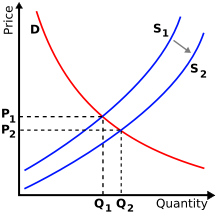
The chart below shows an idealized supply-demand curve:


At historic prices for PV systems (P1), there is only limited customer appetite for domestic and commercial PV installations.  To dramatically increase adoption, government would have to either increase customers' willingness and ability to pay (shifting the demand curve), or reduce the cost of the system by shifting the supply curve.  Price controls and explicit industry handouts are a tricky feat for a government committed to free market mechanisms (more on that below), so DECC opted to shfit the demand curve, say from D1 to D2 in the illustration above. That would shift sales from Q1 to Q2.

DECC wanted the initial feed in tariff to drive a significant increase in adoption, so they set it at 43.1 pence per kilowatt-hour of electrical production for small scale PV systems.  At a time when the carbon markets were paying around €15 per tonne for greenhouse gas reduction measures, DECC offered households and businesses the equivalent of €700 per tonne.

And did that demand curve ever shift!  In 2009, there was only 26.5 megawatts (MW) of installed PV capacity in the United Kingdom.  By the end of 2010 that number had nearly trebled to 76.9 MW.

Then something interesting happened.  The supply curve shifted, too, and by even more.  The Chinese government provided highly subsidised loans to encourage solar manufacturing.  As a result, low-cost production soared as new solar panel manufacturers flooded the market - in many cases driving producers in the U.S. and other countries out of business.  The supply curve shift - from (S1) to (S2) in the illustration below - meant that the average global cost of PV panels dropped from around US $4 per watt to just over $1 per watt in 2011.  Only some of this decrease was passed on to consumers - in the UK the cost of PV systems have fallen by about one-third, but even this could mean a saving of thousands of pounds.

Now, not only did customers have more money with which to purchase PV systems, but prices were falling at the same time.  As a result demand skyrocketed.  Between January and December 2011, installed PV capacity in the UK had jumped nearly ten-fold from 76.9 MW to 750 MW.

This huge increase in PV installations means a relatively huge feed-in-tariff bill for government and electricity rate-payers.  Thus the push to gradually roll back the feed-in tariff, from 43.1 down to 21 pence, and ultimately to 11 pence per kilowatt-hour.

While the costs for the feed-in tariff are dwarfed by other expenditures from petrol to defense to healthcare, they are large enough to spark a debate about the appropriate level of subsidy for renewables in the UK.  The costs of the feed-in tariff are obvious enough: money paid for renewables-based electricity generation comes at the expense of other items, and if the scheme is designed poorly, it might come at the expense of basic necessities for more vulnerable members of society.

The benefits are no less real, but are not always as obvious.  There are the long term financial savings by companies and households that have installed renewable energy systems, the contribution these installations make towards less volatile fuel and power costs, the job creation effects associated with relatively labour-intensive system installation, and of course the contribution to the fight against global climate change.

DECC is hoping that the supply curve for renewables continues to shift to the right, enabling customers to continue installing these systems without further resort to taxpayer or ratepayer subsidy.  So far it is too soon to tell, but the Carbon Clear team will be watching to see how this market develops.

Friday, 24 February 2012

Climate Change Already Harming the World's Forests

Last year I wrote about the effect that climate change has on lianas, the leafy vines that grow around trees in the tropics.  The lianas put stress on the trees, hindering the trees' growth and survival - and thus their ability to sequester carbon dioxide.  And since lianas seem better able to survive drought conditions and make use of increased carbon dioxide in the atmosphere, they form part of a dangerous feedback loop: higher greenhouse gas concentrations + warming, leading to increased liana growth leading to weakened trees leading to less carbon sequestration, leading to higher greenhouse gas concentrations.

As one of the scientists involved in the liana study noted, "All the trees will be very unhappy."

Now we're seeing that it's not just tropical trees that are in trouble.  My old grad school classmate Patrick Gonzalez recently completed a NASA-funded study that shows "significant" declines in tree density and species richness in the Sahel region of Africa. Patrick's study controlled for weather, human population, and other variables, and found that long term temperature and rainfall changes associated with climate change were by far the most important factor in explaining the loss of trees.

Thousands of miles north, scientists in Alaska and British Columbia have found 2,000 year-old yellow cedars succumbing to climate change.  These hardy trees can survive fierce storms, insects and other stresses, but require an insulating layer of snow to protect their roots from freezing soil.  The trees began dying several decades ago as the climate warmed and snow cover receded, but researchers only discovered this vulnerability after eliminating predators and fungi as potential causes and looking at physical factors.

Other evidence is anecdotal.  In January 2012, The Senator, a 38 meter (125 feet) tall pond cypress in Florida burned down.  It was the largest tree in the Eastern United States and at 3,400-3,600 years old, was one of the five oldest trees in the world.  Arson has been ruled out, but it isn't yet clear why a tree that was old when Rome was founded would suddenly catch fire.

The overall picture is that our trees are under threat.  Deforestation has long been a problem around the world, but it is increasingly clear that we are caught in a spiral of climate change and forest loss.

What can be done?

There are three ways we can help save the world's forests and enhance their contribution to ecosystem services.  All three can benefit from innovations in the carbon markets, though we shouldn't expect the carbon markets alone to solve the problem.

First, control emissions.  The majority of greenhouse gas emissions come from human activity: energy use, rice cultivation, livestock rearing.  Initiatives that reduce fossil fuel consumption and reduce methane emissions from agriculture help slow the concentration of greenhouse gas emissions in the atmosphere, and can slow the positive feedback effects that lead to global warming and tree mortality.

Second, protect the remaining forests. The Verified Carbon Standard and other organisations have pioneered mechanisms that allow the use of carbon finance to support local communities and biodiversity while protecting forests from over-harvesting, land use change and other destructive practices.

Third, plant more trees.  Around the world, community based agroforestry and afforestation projects are working to increase the area of new forest land under cultivation.  These initiatives help reduce soil erosion and enhance local incomes while sequestering carbon dioxide in a robust and verfiable manner.

Stay tuned for upcoming announcements of some of the initiatives that Carbon Clear is supporting in the effort to protect and enhance the world's forests.

Monday, 9 January 2012

Corporate Carbon Management - Now More Than Ever

The latest round of international climate change negotiations ended one month ago in Durban.  Now that the dust has settled, we can take stock of what the results mean for corporate carbon management.

There were a number of policy announcements from Durban, but the biggest piece of good news is that government negotiators managed to avoid the worst-case scenario, agreeing to set a path to binding emission reduction targets and agreeing to preserve the Clean Development Mechanism in the interim.  The other piece of good news is that, for the first time, major developing nations like China have agreed to set binding reduction targets as an outcome of future negotiations.

Governments around the world have sent a clear signal to business: emission reduction targets are going to tighten, so get ready.

The bad news from Durban is that the deadlines are much too loose.  The Durban Declaration calls on the parties to finalise a post-Kyoto climate change agreement by 2015, with emission reductions beginning no later than 2020.

These targets reflect the difficulty of agreeing potentially painful greenhouse gas emission reductions amongst scores of states with their own political and economic agendas.  However, they fail to reflect the urgency of the climate change crisis.

Mother Nature does not care that it is an election year.  We will not get a reprieve from record drought, record heat and fires, record floods, coral bleaching, and thawing permafrost.

Climate change is happening today.  While it is too late to prevent climate change, we still have time to minimise its impacts.  As we have seen over the past year, the costs of climate change related impacts can greatly exceed the cost of reducing our emissions.

Many politicians seem to have an incentive to encourage business as usual, but companies are in a different position.  The incentives for early and ambitious action on corporate carbon management are clear.

The writing is already on the wall regarding the need to reduce emissions.  Many governments are already putting carbon reporting and reduction rules in place, and the rest are making noises in this regard. Companies that take action now are

thus in a position to gain first-move advantage developing lower-carbon processes, products and services.

Second, while governments may have signalled that carbon reductions can wait - for a few years at least - customers are

more demanding.  Over and over again, surveys show that consumers think more highly of firms that take carbon management seriously. In the UK and internationally, major firms are embracing sustainability at the senior management level in a race to demonstrate their environmental credentials to the public.

Third, Carbon Clear has documented an increasingly direct link between carbon management and financial performance.  Understanding the greenhouse gas emission drivers in a company requires managers to get a handle on resource flows within the business, the efficiency of their production processes, and the ways in which customers use their products and services.  Developing carbon clarity drives efficiencies and reduces costs throughout the company, with a measurable impact on the bottom line, and benefits that can be felt by customers, employees, investors, the finance team, and other stakeholders.

The corporate sector has the potential to drive huge global emission reductions, not only here but in developing countries that form a huge part of the global supply chain.  While government leadership and policy direction are welcome, there's no need to wait.  The benefits of corporate carbon management and the risks of inaction are a spur to immediate action. We need transformative corporate carbon management now more than ever.

Tuesday, 27 September 2011

Happy Birthday, Carbon Clear!

 
Six years ago today, Carbon Clear was incorporated in the UK.  Back in 2005, the global carbon market was a very different place:
A lot has changed since 2005.  We've been priviliged to witness - and contribute to - the growth and evolution of a thriving ecosystem of companies, institutions and individuals committed to the transition to a low-carbon future.

It's been a successful and busy six years at Carbon Clear, but there is still much more to do.  We look forward to helping our customers and partners transform their relationship with carbon.


(Back to the Carbon Clear Website)