In a recent blog post, I provided a canned summary of the reasons shale gas has become such a burning issue. That previous article covered issues surrounding potential environmental impacts, the relative attractiveness of shale gas compared to coal, and the potential for fugitive methane emissions.
In this post, I want to explore what exploitation of shale gas might imply for our efforts to transition to a low-carbon economy.
As a thought experiment, if we were to suddenly replace all the UK's coal consumption with natural gas, we would reduce greenhouse gas emissions by 42 million tonnes, a saving of nearly 10% from the national footprint total of 458 million tonnes CO2e.
Leaving aside the potential environmental impact of extracting this much shale gas, could we do it? One would think so, judging from breathless headlines like this one in the UK from The Times:
Let's dig into that "43 years" statistic.
The Times article summarizes the findings from a British Geological Survey (BGS) report on the Bowland-Hodder Shale Formation in northern England. According to the BGS, the mid-range estimate for the total gas in place in the Bowland Shale Formation is 1,329 trillion cubic feet (37.6 trillion cubic meters). However, not all of that gas will be recoverable at a reasonable price using foreseeable technology. A reasonable guess might be that 10% will be recoverable - call it 130 trillion cubic feet.
2012 gas consumption in the UK was approximately 3 trillion cubic feet - a figure that has actually declined slightly since 2000, as utilities burn more coal to produce power.
Divide the recoverable gas estimates (130 tcf) by current consumption (3 tcf/year) and you get 43 years. Not exactly cutting edge analysis, but easy to explain.
But is this number useful for anything besides headlines?
The first assumption we might question is that gas consumption will remain constant for the next four decades. In the U.S., an influx of cheap gas has encouraged utilities to reduce coal consumption and shelve plans for new coal-fired generation; gas consumption increased by one-third in less than a decade. If, as we expect, shale gas in the UK is cheaper than conventional gas supplies, gas consumption will rise to displace at least some of the UK's coal-fired power plants. If gas were to completely replace coal and energy consumption otherwise stays flat, natural gas use could rise by nearly 50%, as indicated in the EIA chart below:
If, as expected, electric vehicles make significant gains over the next few
decades, then natural gas use could rise still further as gas-fired
electricity displaces petroleum. Even this simple analysis shows that natural gas use could rise dramatically - even if overall UK energy demand does not increase.
However, the Office of National Statistics expects the country's population to rise 30% over the next four decades. Without significant efforts to improve reduce energy demand and shift to renewable energy sources, this projected population increase makes the assumption of constant gas demand even more untenable.
At this point in the analysis, we are piling guesses on top of guesses. Coming back to our original question, yes, we could completely displace UK coal consumption and drive significant emission reductions, but not for as long as the headlines would have you believe.
And what happens once we've used up that shale gas bounty? Either we lurch back to a heavy dependence on coal, causing greenhouse gas emissions and air pollution to skyrocket, or we switch to lower carbon sources of power like PV, wind, wave, and geothermal - or nuclear.
Interestingly, it would likely take 15-20 years to fully build out renewables on a truly massive scale, along with the electricity transmission and smart grid infrastructure required to make best use of decentralized and intermittent renewable resources. Likewise, it would probably take 20-30 years for nuclear power to stage a significant comeback in the United Kingdom. Whether we employ renewables, nuclear or both is an important debate, but on for another day.
The shale gas revolution, should we choose to exploit it, has the potential to buy us some time. If we can resolve the far-from-trivial environmental and other challenges facing hydraulic fracturing, we can achieve significant greenhouse gas emission reductions today, even as we build a longer-term low-carbon energy infrastructure for tomorrow.
Showing posts with label economics. Show all posts
Thursday, 18 July 2013
Thursday, 11 July 2013
The Shale Gas Panacea (Part 1)
If you want start an argument, just ask a group of environmentalists what they think about shale gas.
Then pass the popcorn.
Conventional natural gas is pumped from vast underground pools like the deposits found under the North Sea, in Russia and in Saudi Arabia. Geologists have long known that there was also a huge amount of gas and oil trapped in tiny bubbles in sedimentary rock called shale, spread across vast territories around the world. However, traditional drilling techniques could not access this gas in a cost-effective manner; by comparison, it was far more cost effective to build and operate a drilling rig in the North Sea than drill for shale gas in Montana.
Two technological breakthroughs changed all that. The introduction of horizontal drilling meant resource extraction companies could drill a network of wells covering a huge area from a single drilling site, without displacing overlying farms, fields and even towns. Hydraulic fracturing, or "fracking", meanwhile, provided a means of crushing shale rock using high-pressure fluid, without strip mining the area. Once the rock is crushed, any pockets of gas or oil trapped in the rock would flow out along the path of least resistance - typically back along the tunnel created by the drill.
Suddenly, it became possible to extract tremendous quantities of shale gas and shale oil, overturning common assumptions about the availability of fossil fuels. As a result of the shale gas boom, natural gas prices in the United States are a fraction of the international gas price.
By 2015, the U.S. is expected to overtake Saudi Arabia as the world's biggest gas producer as energy companies tap the Marcellus, Bakken and other shale basins. In the UK, meanwhile, analysts are reporting breathlessly about the potential of the Bowland Basin, which some claim can supply the country with gas for the next 43 years. I'll be taking a closer look at that number next time, but for now let's agree that there's a lot of gas down there.
Why might this be good news for environmentalists? Per unit of energy, natural gas has a much lower greenhouse gas emissions intensity than coal or oil. In the United States, an abundance of cheap shale gas is ruining the economics of coal-fired power plants. In 2005, gas accounted for 19% of the country's electricity production; in 2012 this figure was 30%. Largely as a result, America's greenhouse gas emissions are falling rapidly - even before President Obama's proposed regulation of power station emissions comes into effect. Here in the UK, low prices for EU ETS permits reduce the incentive for power station operators to reduce emissions; it's cheaper to burn coal and buy a permit than use expensive gas. In addition to its CO2 emissions, coal combustion also releases mercury into the environment and contributes more to ambient air pollution than does burning gas. A massive influx of cheap gas could reduce output at the UK's coal-fired power plants, and force operators to shelve plans for new coal-fired generation. A cleaner environment and lower greenhouse gas emissions would be the result.
Why might the fracking revolution be bad news for environmentalists? For one thing, we need to be clear about what fuel shale gas is displacing. Not all that American coal is staying in the ground: as demand for coal falls in the U.S., its price has plummeted. As a result, it has been cost effective for some European utilities to buy (relatively) cheap American coal instead of more expensive European and Middle Eastern gas. Coal imports from the U.S. were up 23% in 2012. Seen at a global level, shale gas production may be displacing...gas, not coal.
In addition, hydraulic fracturing is not a tidy process. The hydraulic fluid is a potent chemical brew and has the potential to contaminate local groundwater supplies. Changes to underlying rock formations have led to a spate of earthquakes in some areas after the introduction of fracking. And many environmentalists are concerned that the gas may not always flow as intended - unplanned releases of inflammable gas can pose a safety hazard, and with a 100-year global warming potential 21 times greater than CO2, natural gas releases from fracking could undo some of the benefit that comes from displacing coal. Other studies argue that this fear is overblown, and energy companies have both the capability and financial incentive to minimise leaks.
While this debate will rage on, I predict that there will be some fracking in the UK, and it will continue to grow in the U.S. The question, then, is whether we can mitigate potential harmful environmental impacts, and use this resource boon as wisely as possible.
We'll return to this issue in a subsequent article.
Then pass the popcorn.
Conventional natural gas is pumped from vast underground pools like the deposits found under the North Sea, in Russia and in Saudi Arabia. Geologists have long known that there was also a huge amount of gas and oil trapped in tiny bubbles in sedimentary rock called shale, spread across vast territories around the world. However, traditional drilling techniques could not access this gas in a cost-effective manner; by comparison, it was far more cost effective to build and operate a drilling rig in the North Sea than drill for shale gas in Montana.
Two technological breakthroughs changed all that. The introduction of horizontal drilling meant resource extraction companies could drill a network of wells covering a huge area from a single drilling site, without displacing overlying farms, fields and even towns. Hydraulic fracturing, or "fracking", meanwhile, provided a means of crushing shale rock using high-pressure fluid, without strip mining the area. Once the rock is crushed, any pockets of gas or oil trapped in the rock would flow out along the path of least resistance - typically back along the tunnel created by the drill.
Suddenly, it became possible to extract tremendous quantities of shale gas and shale oil, overturning common assumptions about the availability of fossil fuels. As a result of the shale gas boom, natural gas prices in the United States are a fraction of the international gas price.
By 2015, the U.S. is expected to overtake Saudi Arabia as the world's biggest gas producer as energy companies tap the Marcellus, Bakken and other shale basins. In the UK, meanwhile, analysts are reporting breathlessly about the potential of the Bowland Basin, which some claim can supply the country with gas for the next 43 years. I'll be taking a closer look at that number next time, but for now let's agree that there's a lot of gas down there.
Why might this be good news for environmentalists? Per unit of energy, natural gas has a much lower greenhouse gas emissions intensity than coal or oil. In the United States, an abundance of cheap shale gas is ruining the economics of coal-fired power plants. In 2005, gas accounted for 19% of the country's electricity production; in 2012 this figure was 30%. Largely as a result, America's greenhouse gas emissions are falling rapidly - even before President Obama's proposed regulation of power station emissions comes into effect. Here in the UK, low prices for EU ETS permits reduce the incentive for power station operators to reduce emissions; it's cheaper to burn coal and buy a permit than use expensive gas. In addition to its CO2 emissions, coal combustion also releases mercury into the environment and contributes more to ambient air pollution than does burning gas. A massive influx of cheap gas could reduce output at the UK's coal-fired power plants, and force operators to shelve plans for new coal-fired generation. A cleaner environment and lower greenhouse gas emissions would be the result.
Why might the fracking revolution be bad news for environmentalists? For one thing, we need to be clear about what fuel shale gas is displacing. Not all that American coal is staying in the ground: as demand for coal falls in the U.S., its price has plummeted. As a result, it has been cost effective for some European utilities to buy (relatively) cheap American coal instead of more expensive European and Middle Eastern gas. Coal imports from the U.S. were up 23% in 2012. Seen at a global level, shale gas production may be displacing...gas, not coal.
In addition, hydraulic fracturing is not a tidy process. The hydraulic fluid is a potent chemical brew and has the potential to contaminate local groundwater supplies. Changes to underlying rock formations have led to a spate of earthquakes in some areas after the introduction of fracking. And many environmentalists are concerned that the gas may not always flow as intended - unplanned releases of inflammable gas can pose a safety hazard, and with a 100-year global warming potential 21 times greater than CO2, natural gas releases from fracking could undo some of the benefit that comes from displacing coal. Other studies argue that this fear is overblown, and energy companies have both the capability and financial incentive to minimise leaks.
While this debate will rage on, I predict that there will be some fracking in the UK, and it will continue to grow in the U.S. The question, then, is whether we can mitigate potential harmful environmental impacts, and use this resource boon as wisely as possible.
We'll return to this issue in a subsequent article.
Labels:
carbon emissions,
carbon reduction,
climate change,
economics
Tuesday, 29 January 2013
Carbon Offsets - The Air Passenger Duty Excuse
Aircraft are one of the fastest growing sources of greenhouse gas emissions worldwide. While the per-kilometer carbon emissions from flying economy class are about the same as those from driving alone in a car, an airplane can cover any given distance much, much faster. You might generate the same CO2 emissions from a single 12-hour flight as you would from a year of driving. The climate change impact becomes even greater when you consider the indirect warming impacts of high altitude flights, which can double the overall warming compared to burning those same fossil fuels on the ground.
What is more, aircraft flights are often discretionary - at least compared to other greenhouse gas sources like producing food, heating our homes and generating electricity. As a result, flight emissions tend to come under special scrutiny by sustainability teams, environmental campaigners, and - importantly - politicians.
Which brings us to Air Passenger Duty (APD).
In December 2006, the then-Chancellor, Gordon Brown, announced that the Government would double Air Passenger Duty rates for UK flights. The rates were raised again in 2009, and then in 2010, and again in 2012. They are scheduled to rise again in April 2013. APD was originally introduced in 1993 solely as a means of raising revenue from the relatively lightly taxed airline industry. However, Brown justified doubling the APD on environmental grounds, and hinted that it would be earmarked to "secure extra resources...for our priorities, such as public transport and the environment." According to the BBC, the Government continues to make environmental claims for APD rises, and campaigning organisations like Greenpeace argue that increases help ensure that airlines pay their proper environmental cost.
Air Passenger Duty costs £13 for a short-haul flight, rising in tiers up to a maximum charge of £92 for flights over 6,000 miles, and brings in over £2 billion in revenue. The duty is several times the cost to purchase carbon credits that would balance out those flight emissions. It might seem reasonable, therefore, for the average passenger or company travel coordinator to avoid purchasing carbon offsets, on the assumption that they have more than paid for the environmental cost of their flights already.
It might seem reasonable, but it would be wrong.
Anyone familiar with the story of the Carbon Reduction Commitment Energy Efficiency Scheme will be unsurprised to learn how the Government uses the revenues from thAPD. A quick recap:iIn December 2011, the Chancellor announced that CRC revenues at £12/tonne CO2 would no longer be "recycled" back to participating companies as an incentive to save energy. Nor would they be "hypothecated" and earmarked solely to environmental and energy efficiency initiatives. Instead, the funds now go into the general revenue pool for use as the Government sees fit.
The same applies to Air Passenger Duty. While the purchase of a quality carbon offset credit directs funds towards a real emission reduction that has been verified by an auditor, Air Passenger Duty payments go into the general tax revenue pool, where they are added to funds from every other source. There is no requirement to hypothecate those revenues towards emission reduction activities, and no direct link between APD revenues and Government spending to tackle climate change.
APD is not even structured to provide strong incentives to reduce emissions. Because it is levied on a per-passenger basis and not per plane or per litre of fuel, APD provides little direct incentive for airlines to fly fewer, fuller planes, or to fly newer, more fuel efficient aircraft.
With an increasing number of experts concerned that we are on track to disastrous climate change, it is more important than ever that we use all the tools at our disposal to reduce global emissions. However, APD has only a marginal impact on aircraft emissions. The revenue is not reinvested directly into emission reduction activities and its pricing structure does not drive down passenger numbers effectively. In its current form, then, APD is not a credible alternative to offsetting your flight emissions with carbon credits.
If you can avoid flying, then by all means do so But if you must fly, there is no real alternative to carbon credits to offset those emissions.
Monday, 29 October 2012
From the Archives: New Fossil Fuel Sources and Climate Change
Over the past few months the debate about new fossil fuel sources has gotten pretty...intense. In the U.S. environmentalists are campaigning in the courts and in farmers fields to halt the Keystone XL pipeline, which will provide easier market access for petroleum from Canada's tar sands. Here in the U.K. campaigners are working to slow the spread of hydraulic fracturing, which enables drillers to access abundant but otherwise difficult to access shale gas.
This is an important debate, and one I discussed in a blog post over three years ago. Rather than rehash that discussion, I will reprint that March 2009 post below:
Peak Oil: Will We Freeze or Roast? Originally posted 18 March 2009
When I was in graduate school in the early 1990s, M. King Hubbert was a name known only to fellow energy nerds. Now, he's so popular you can get regular news alerts.
Hubbert developed a mathematical model describing how production from an oil well or entire oil producing region tends to increase at a predictable rate, until it hits a - predictable - peak and then declines. Hubbert used his model to predict the year of peak oil output for the United States, and it has been used more or less successfully for other oil producing regions since then.
In addition to forecasting output growth for particular regions, the Hubbert Curve and peak oil theory can be applied to oil production for the world as a whole. But as recently as 2005, the International Energy Agency (IEA) dismissed the concept. Mainstream energy agencies tended to assume that oil production could increase indefinitely as new investment and technology are brought to bear. If a peak exists, they argued, we are nowhere near it.
This matters because when the world's leading climate scientists prepared their 2007 report on global warming trends and impacts, they turned to the IEA for their best estimates of fossil fuel consumption. The IPCC works by consensus, and its reports tend to refer only to the most authoritative sources. The IEA estimates showed that conventional fossil fuel use would continue to grow without end, and this prediction is reflected in all the pessimistic warnings about global temperature increases and climate change.
Times have changed. The IEA is now predicting that we will reach global peak oil between 2020 and 2030 (more pessimistic scenarios argue that we reached the global peak last year). So oil production will top out much earlier than anticipated.
Less petroleum production means fewer petroleum-related greenhouse gas emissions. In fact, manyindependent models suggest that, once peak oil (and coal) is factored in, we simply can't burn enough traditional fossil fuels to reach the worst-case global warming levels.
Let me repeat that: Most climate models that incorporate peak oil theory predict a temperature rise of less than 2 degrees Centigrade. A major change to be sure, but far less than the IPCC's "business as usual" scenario for global warming.
So, this is good news, isn't it? Climate change is solved because fossil fuel production will decline sooner than predicted, right?
Not so fast. What are we going to use for our vehicles when the oil starts to run out? Shall we simply switch off the lights and freeze?
In 2006, Alex Farrell and Adam Brandt, researchers at the University of California at Berkeley's Energy and Resources Group, published a paper that examined the cost, availability and climate change implications of substitutes for conventional petroleum. These are liquid fuels derived from heavy, difficult to process resources like tar sands, oil shale, and coal.
The Berkeley team found that it would be commercially viable to produce synthetic petroleum from these heavy fuels at oil prices of less than US $50 per barrel. What's more these resources are so abundant that they would keep pump prices relatively low.
In other words, peak oil means less petroleum, but not an end to fossil fuels. For those who worry that peak oil means society will collapse into "Mad Max" - style anarchy, that's good news.
The bad news is that these fuels have a much greater climate change impact than conventional oil. Using tar sands and heavy oil results in about 50% more CO2 per unit of energy than regular petroleum. Synthetic fuels made from coal nearly doubles the greenhouse gas emissions, and using oil shale could result in up to 3X the emissions per unit of energy. To quote the authors:
"Overall...the oil transition is not a shift from abundance to scarcity: fossil fuel resources abound. Rather, the oil transition is a shift from high quality resources to lower quality resources that have increased risks of environmental damage, as well as other risks."
Sadly, peak oil is not the solution to climate change. If anything, a poorly planned response to peak oil could accelerate global greenhouse gas emissions growth.
There is an alternative. We have the technical know-how to produce energy from low- or zero-emission sources. Solar, hydropower, wave and tidal, wind, and geothermal energy are clean sources of hydrogen and electricity, and carefully chosen biofuels can provide high energy-density liquid fuels.
Scaling up these clean energy technologies at the rate required to compensate for peak oil and limite climate change is a challenge. But as discussed in an earlier article, the required investments by governments, corporations and communities are no larger than other causes on which we have spent billions. The need is arguably as great, if not greater, because poorly planned energy investments made today will have a huge impact for decades to come.
Labels:
carbon emissions,
carbon reduction,
climate change,
economics,
impacts,
solutions
Tuesday, 18 September 2012
Carbon Clear's Autumn Breakfast Briefings: Telling the Story
There are only two days to go before the launch of Carbon Clear's autumn Breakfast Briefing series. A good deal of thought went into these sessions, and I like to think they come together to tell a compelling story. Here's how they fit together.
The first session, on 20 September, will cover the UK Government's new Mandatory Carbon Reporting legislation, which I blogged about a few weeks ago. I'll be joined at that session by my colleague Vincent Reulet and by Mardi McBrien, MD of the Carbon Disclosure Standards Board.
We'll be talking about why the Government is pushing for mandatory carbon reporting, how this new requirement fits in with other carbon reporting efforts like the EU ETS, the Carbon Disclosure Project and the Carbon Reduction Commitment Energy Efficiency Scheme (CRC), and how companies can both comply with this legislation and use it to gain competitive advantage. Should be an informative and dynamic event.
A few weeks later, on 2 October, we will be talking about what I sometimes refer to as Carbon Offsetting 2.0. After the first wave of carbon offsetting in the mid- to late-2000s, there was a lull. Now, a new crop of companies, from Microsoft to Marks & Spencer, are announcing carbon neutrality programmes. We'll be discussing how this new round of carbon offsetting differs from the first, and how other companies can benefit.
Then, on 17 October we will be unveiling our Carbon Maturity whitepaper. Our crack team of consultants has pooled decades of accumulated experience working with over a hundred companies to develop a model of corporate carbon maturity. We've found that companies at each stage of the maturity curve share certain characteristics and encounter similar obstacles before moving on to the next level. This applies to both their internal carbon management activities and their carbon offsetting initiatives. Delegates at this briefing will learn how the carbon maturity model works, and how to benchmark their companies' performance against other businesses.
The breakfast briefing series, then, tells a story. We start with carbon footprinting and show how it can go from being a burden to a source of competitive advantage. We then move on to carbon offsetting and show how it has evolved to become a source of real business value for the largest companies. And then we describe how companies around the world are developing increasingly sophisticated carbon management programmes that deliver benefits for management, employees, investors and the wider community.
I think that's a story that every company should hear. Join us, and help tell the story.
The first session, on 20 September, will cover the UK Government's new Mandatory Carbon Reporting legislation, which I blogged about a few weeks ago. I'll be joined at that session by my colleague Vincent Reulet and by Mardi McBrien, MD of the Carbon Disclosure Standards Board.
We'll be talking about why the Government is pushing for mandatory carbon reporting, how this new requirement fits in with other carbon reporting efforts like the EU ETS, the Carbon Disclosure Project and the Carbon Reduction Commitment Energy Efficiency Scheme (CRC), and how companies can both comply with this legislation and use it to gain competitive advantage. Should be an informative and dynamic event.
A few weeks later, on 2 October, we will be talking about what I sometimes refer to as Carbon Offsetting 2.0. After the first wave of carbon offsetting in the mid- to late-2000s, there was a lull. Now, a new crop of companies, from Microsoft to Marks & Spencer, are announcing carbon neutrality programmes. We'll be discussing how this new round of carbon offsetting differs from the first, and how other companies can benefit.
Then, on 17 October we will be unveiling our Carbon Maturity whitepaper. Our crack team of consultants has pooled decades of accumulated experience working with over a hundred companies to develop a model of corporate carbon maturity. We've found that companies at each stage of the maturity curve share certain characteristics and encounter similar obstacles before moving on to the next level. This applies to both their internal carbon management activities and their carbon offsetting initiatives. Delegates at this briefing will learn how the carbon maturity model works, and how to benchmark their companies' performance against other businesses.
The breakfast briefing series, then, tells a story. We start with carbon footprinting and show how it can go from being a burden to a source of competitive advantage. We then move on to carbon offsetting and show how it has evolved to become a source of real business value for the largest companies. And then we describe how companies around the world are developing increasingly sophisticated carbon management programmes that deliver benefits for management, employees, investors and the wider community.
I think that's a story that every company should hear. Join us, and help tell the story.
Thursday, 13 September 2012
Who's Afraid of Low Carbon Prices? Part 3: Not Australia
Last week I attended a briefing at the Australian High Commission in London. The Victorian Government (the Australian state, not the 19th century ruler) hosted a session for carbon market participants to present the latest updates to the country's ambitious greenhouse gas cap-and-trade scheme.
The Australian carbon pricing initiative begins as a straightforward carbon tax, set at A$23 (€19), indexed to inflation and payable by the largest 500 or so industrial polluters. European carbon allowances, by contrast, were trading below €8 yesterday. That price difference initially attracted howls of protest from industry lobbyists.
From July 2015, however, Australia switches from a carbon tax to a cap-and-trade scheme linked to the EU-ETS. That means Australian companies will be able to buy European credits (EUAs), and to an extent UN-issued CERs to comply with up to 50% of their carbon reduction obligations. Similarly, Europeans will be able to buy Australian Allowances to satisfy EU abatement requirements.
The EU-Australia linkup is not a marriage of equals, however. The EU is directly responsible for 11% of global greenhouse gas emissions, while Australia emits just 1.5% of the global total - about the same as the United Kingdom. The additional supply of relatively cheap EU allowances is expected to dwarf the additional demand for allowances generated by Australia's emissions-intensive firms. If the business-as-usual EUA price remained at €8 in 2015 and all else being equal, we should expect the carbon price for the linked systems to equalise much closer to the EUA price - somewhere around €9.30.
This analysis indicates that linking the two carbon trading schemes might cut the Australian carbon price in half. In reality, the EU expects the carbon price to rise by 2015, but still much lower than the Australian carbon tax level. Isn't that bad news for Australia? Surely we need high carbon prices to drive emission reductions?
That might be true if the Australians had magically built a dome over their country and were the only people affected by the carbon emissions. The reality is that Australia's greenhouse gas emissions contribute to climate change across the planet. Similarly, the CO2 from a Polish or American power station adds to the global atmospheric buildup contributing to droughts and flooding in Australia.
Global atmospheric circulation means that an emission reduction anywhere helps the climate everywhere and vice versa. If we need to save 1 million or 1 billion tonnes of CO2, it doesn't matter too much where that savings happens. What is important for climate change is that this savings happens sooner rather than later.
As I discussed in an earlier blog post, the emissions trading scheme is a price discovery mechanism that helps us identify the most cost effective emissions reduction opportunities across the entire scheme. So a relatively low carbon price for a combined Australia-EU trading systems means there are significant opportunities to reduce green house gas emissions with minimal economic impact. It means the Australian Government can make its contribution to curbing global climate change even cheaper and faster than before. The market can work, and that's a good news story.
It also means that there are still major carbon reduction opportunities that we (including Australia) are not pursuing. And that's bad news. One analysis says that global greenhouse gas emissions need to peak by 2015 and then decline year on year if we are to limit average global temperature increases to a damaging but not wholly catastrophic 2 degrees. A low carbon price means we continue to fight this battle with one arm tied behind our collective back. It means governments are still failing to set sufficiently ambitious targets to set us on a path towards a low-carbon future.
The Australian carbon pricing initiative begins as a straightforward carbon tax, set at A$23 (€19), indexed to inflation and payable by the largest 500 or so industrial polluters. European carbon allowances, by contrast, were trading below €8 yesterday. That price difference initially attracted howls of protest from industry lobbyists.
From July 2015, however, Australia switches from a carbon tax to a cap-and-trade scheme linked to the EU-ETS. That means Australian companies will be able to buy European credits (EUAs), and to an extent UN-issued CERs to comply with up to 50% of their carbon reduction obligations. Similarly, Europeans will be able to buy Australian Allowances to satisfy EU abatement requirements.
The EU-Australia linkup is not a marriage of equals, however. The EU is directly responsible for 11% of global greenhouse gas emissions, while Australia emits just 1.5% of the global total - about the same as the United Kingdom. The additional supply of relatively cheap EU allowances is expected to dwarf the additional demand for allowances generated by Australia's emissions-intensive firms. If the business-as-usual EUA price remained at €8 in 2015 and all else being equal, we should expect the carbon price for the linked systems to equalise much closer to the EUA price - somewhere around €9.30.
This analysis indicates that linking the two carbon trading schemes might cut the Australian carbon price in half. In reality, the EU expects the carbon price to rise by 2015, but still much lower than the Australian carbon tax level. Isn't that bad news for Australia? Surely we need high carbon prices to drive emission reductions?
That might be true if the Australians had magically built a dome over their country and were the only people affected by the carbon emissions. The reality is that Australia's greenhouse gas emissions contribute to climate change across the planet. Similarly, the CO2 from a Polish or American power station adds to the global atmospheric buildup contributing to droughts and flooding in Australia.
Global atmospheric circulation means that an emission reduction anywhere helps the climate everywhere and vice versa. If we need to save 1 million or 1 billion tonnes of CO2, it doesn't matter too much where that savings happens. What is important for climate change is that this savings happens sooner rather than later.
As I discussed in an earlier blog post, the emissions trading scheme is a price discovery mechanism that helps us identify the most cost effective emissions reduction opportunities across the entire scheme. So a relatively low carbon price for a combined Australia-EU trading systems means there are significant opportunities to reduce green house gas emissions with minimal economic impact. It means the Australian Government can make its contribution to curbing global climate change even cheaper and faster than before. The market can work, and that's a good news story.
It also means that there are still major carbon reduction opportunities that we (including Australia) are not pursuing. And that's bad news. One analysis says that global greenhouse gas emissions need to peak by 2015 and then decline year on year if we are to limit average global temperature increases to a damaging but not wholly catastrophic 2 degrees. A low carbon price means we continue to fight this battle with one arm tied behind our collective back. It means governments are still failing to set sufficiently ambitious targets to set us on a path towards a low-carbon future.
Thursday, 5 July 2012
Going Mainstream
This is interesting:
At Carbon Clear, we've been saying this for years, but nice to see this mantra make the cover of CFO Magazine. (Hat tip: @greenmondaynews)
Labels:
business,
corporate brand image,
economics,
FTSE,
philosophy,
solutions,
sustainability
Monday, 18 June 2012
Tweeting Against Fossil Fuel Subsidies is Fine, but...
There is a 24-hour "Twitterstorm" currently running to mark the Rio+20 environmental conference in Brazil. The #EndFossilFuelSubsidies tweet-a-thon is being organised by environmental group 350.org, to help push the issue onto the agenda of world leaders attending the conference.
The logic behind the campaign is obvious: fossil fuel combustion is the single largest source of man-made greenhouse gas emissions. We burn excessive fossil fuels in part because we fail to factor their environmental impact into the price. Carbon taxes and cap-and-trade schemes are intended to help send more accurate (higher) price signals and thereby reduce demand. However, not only are we failing to implement aggressive carbon pricing schemes, nations around the world actually offer billions of dollars of subsidies that lower the price of fossil fuel production and consumption. Other subsidies are non-financial: relaxing environmental restrictions in protected areas reduces compliance costs for fossil fuel producers, making it easier to increase supply at a given price.
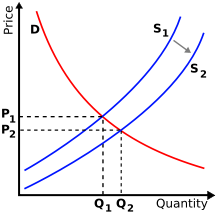
What would compel otherwise rational decision makers to support such an illogical policy? In a nutshell, it's a lack of joined up thinking. Why subsidise fossil fuel production? To shift the supply curve out to the right - increasing supply, reducing price, or both, as seen below:
Why do we need to increase supply? Because we are consuming increasing quantities of fossil fuels. Why are we consuming so much? Because we are not using renewables. Because our buildings are inefficient, and we travel long distances in inefficient vehicles, and we manufacture large quantities of products in inefficient factories.
Why subsidise fossil fuel consumption? Because otherwise influential voters would revolt, poorer members of society would face fuel poverty, and manufacturers would threaten to take jobs elsewhere. Why are voters, households and employers sensitive to the price of fuel? Because their homes, vehicles and buildings use energy inefficiently and because they do not generate much, if any, of their own local power.
In other words, when confronted with the challenge of people using energy wastefully and failing to use locally available renewables, national leaders have responded with subsidies that boost production and lower the price of fossil fuels! You can see how policy makers might find this response rational on a case-by-case basis, but from a broader systems perspective the case for these subsidies becomes ludicrous. This "solution" becomes even more appalling when one considers the environmental cost.
A "big-picture" systems view can tackle these challenges simultaneously from an economy-wide and a local level. If it is too expensive to drive vehicles long distances when people must face the full cost of fuel, then we can find ways to reduce vehicle miles per person or per tonne of goods: putting homes or factories closer to offices, increasing fuel efficiency, and using mass transit to reduce the number of cars people need to own. If fuel costs are making homes unaffordable and businesses uncompetitive, then we can find ways to get the same benefits with less fuel: switch to renewables, where the "fuel" (sunlight, wind, etc) is free; or improve building and appliance efficiency so less energy is wasted.
#EndFossilFuelSubsidies is a clever campaign, but we need more systems-level thinking if it is to become more than a slogan that disappears after 24 hours.
Thursday, 3 May 2012
Carbon Capture and Storage: What's the Big Deal?
The U.S. Department of Energy has released the North American Carbon Storage Atlas (NACAS). The atlas is a compendium of geologic sites across Canada, the United States and Mexico where it is theoretically possible to store CO2 produced from stationary sources like power plants, cement factories and the like.
The idea is that this atlas would be used to find and evaluate carbon storage sites close to big greenhouse gas emitters across the continent. This, in turn, would help to improve the economics of carbon capture and storage (CCS) by reducing the logistics costs associated with transporting millions or billions of tonnes of liquified CO2 long distances.
Carbon capture and storage is one of a number of potential tools we can wield in the fight against climate change. The technology has many variants, but the basic approach is to use chemical or mechanical systems to capture CO2 from exhaust gase. Another approach is to chemically remove and capture the CO2 from the fuel before it is burned. In either case, the CO2 is then liquified under pressure, transported to a geologic storage site, and injected into underground basins, where it intended to remain for hundreds of years. After all, CO2 from burning fossil fuels only contributes to global warming if the gas is released to the atmosphere.
NACAS researchers estimate a potential storage capacity of 136 billion tonnes of CO2 in oil and gas fields (where CO2 injection can also release the last remaining oil, which ironically will release more CO2 when burned); 65 billion tonnes in coal fields; and 1.7trillion tonnes in saline reservoirs.
How does that compare to current emissions? In 2010 U.S. greenhouse gas emissions were approximately 6 billion tonnes CO2 equivalent, with 2.25 billion tonnes from electric power plants. So there is enough potential storage in oil, gas and coal fields to storage 88 years of CO2 from power plants, at today's rates of emissions. If coal consumption increased as a result of population growth, economic activity or the lack of viable alternatives, this storage potential would not go as far. And while saline reservoirs have the potential to hold several centuries' worth of CO2, appreciable injection rates can only be achieved at present with hydraulic fracturing (or "fracking"), a process that has caused tremendous concern when used to extract shale gas.
The North American Carbon Storage Atlas therefore serves a useful role in highlighting the theoretical potential of CCS in the fight against climate change. However, it is still not clear whether CCS can play a practical role. One rule of thumb is that commercial-scale CCS would consume approximately 20% of a power plant's output, which means that each unit of electricity sold to end users would be that much more expensive. That figure does not include the cost to transport the liquid CO2 to the injection site and pump it into a storage reservoir 3 kilometers deep. These cost considerations raise doubts about the potential of CCS at a time when wind and other clean energy technologies are falling rapidly in cost, and with governments unable or unwilling to invest billions in pilot schemes to perfect the technology.
The debate over CCS has now shifted to the U.N. Clean Development Mechanism, where proponents are exploring the use of carbon credits sales to help overcome the financial and technical barriers to implementation. Work continues on this front, with the CDM in its CMP 7 report in Durban agreeing to explore ways to develop acceptable rules governing long-term liability, site safety, permanence of the emission reductions, and a host of other issues.
I generally advocate a team approach to carbon reduction, where we pursue multiple emission reduction measures at the same time. However, CCS is potentially so big that, despite its challenges it bears watching closely. Stay tuned.
The idea is that this atlas would be used to find and evaluate carbon storage sites close to big greenhouse gas emitters across the continent. This, in turn, would help to improve the economics of carbon capture and storage (CCS) by reducing the logistics costs associated with transporting millions or billions of tonnes of liquified CO2 long distances.
Carbon capture and storage is one of a number of potential tools we can wield in the fight against climate change. The technology has many variants, but the basic approach is to use chemical or mechanical systems to capture CO2 from exhaust gase. Another approach is to chemically remove and capture the CO2 from the fuel before it is burned. In either case, the CO2 is then liquified under pressure, transported to a geologic storage site, and injected into underground basins, where it intended to remain for hundreds of years. After all, CO2 from burning fossil fuels only contributes to global warming if the gas is released to the atmosphere.
NACAS researchers estimate a potential storage capacity of 136 billion tonnes of CO2 in oil and gas fields (where CO2 injection can also release the last remaining oil, which ironically will release more CO2 when burned); 65 billion tonnes in coal fields; and 1.7trillion tonnes in saline reservoirs.
How does that compare to current emissions? In 2010 U.S. greenhouse gas emissions were approximately 6 billion tonnes CO2 equivalent, with 2.25 billion tonnes from electric power plants. So there is enough potential storage in oil, gas and coal fields to storage 88 years of CO2 from power plants, at today's rates of emissions. If coal consumption increased as a result of population growth, economic activity or the lack of viable alternatives, this storage potential would not go as far. And while saline reservoirs have the potential to hold several centuries' worth of CO2, appreciable injection rates can only be achieved at present with hydraulic fracturing (or "fracking"), a process that has caused tremendous concern when used to extract shale gas.
The North American Carbon Storage Atlas therefore serves a useful role in highlighting the theoretical potential of CCS in the fight against climate change. However, it is still not clear whether CCS can play a practical role. One rule of thumb is that commercial-scale CCS would consume approximately 20% of a power plant's output, which means that each unit of electricity sold to end users would be that much more expensive. That figure does not include the cost to transport the liquid CO2 to the injection site and pump it into a storage reservoir 3 kilometers deep. These cost considerations raise doubts about the potential of CCS at a time when wind and other clean energy technologies are falling rapidly in cost, and with governments unable or unwilling to invest billions in pilot schemes to perfect the technology.
The debate over CCS has now shifted to the U.N. Clean Development Mechanism, where proponents are exploring the use of carbon credits sales to help overcome the financial and technical barriers to implementation. Work continues on this front, with the CDM in its CMP 7 report in Durban agreeing to explore ways to develop acceptable rules governing long-term liability, site safety, permanence of the emission reductions, and a host of other issues.
I generally advocate a team approach to carbon reduction, where we pursue multiple emission reduction measures at the same time. However, CCS is potentially so big that, despite its challenges it bears watching closely. Stay tuned.
Monday, 30 April 2012
Low-Carbon Energy: Not Just for Treehuggers
Not so long ago, few organisations would have invested in renewable energy systems to power their operations. Those that did, like HSBC or Google, did so for largely for publc relations or CSR purposes, or because senior managers were also committed environmentalists. Rarely was it possible to make a more traditional business case for such investments.
How times have changed.
As the New York Times reports, the U.S. military, not known as a bastion for tree-huggers, has embraced renewable energy on its largest bases. Fort Bliss, the largest Army base in America, is as large as a small state, and recently completed a $1 million investment in solar photovoltaics. Next year will likely see the start of construction on a new 20 MW solar farm, enough to power an entire town. This system is part of a longer term plan that includes wind turbines, heat pumps, and waste-to-energy systems. All of these, together with aggressive energy efficiency measures, are intended to help the base achieve "net zero" energy consumption, as well as net zero water and waste, by 2018. It shares this goal with Fort Carson in Colorado, but Fort Bliss faces a special challenge, with the number of troops stationed at the base expected to triple by 2015.
The U.S. Army is not investing millions into renewable energy for the corporate social responsibility benefit. It is not doing so for stakeholder engagement. Rather, these technologies simply make financial and operational sense. Renewables have higher up-front costs than fossil fuels, but have considerably lower running costs. With fuel prices likely to continue rising into the future even as budgets shrink, renewables represent a long-term investment in financial cost management by the military. What is more, using renewable energy on a widespread basis on the country's largest bases gives soldiers and staff operational experience using these technologies. Military planners expect renewables to become more useful in field deployments in future, so the more comfortable soldiers are using them before they head overseas, the better.
The military is not alone in their newfound appreciation of renewable energy. As the cost of PV panels has fallen, the justifications for going green continue to multiply. Renewable energy systems not only help to achieve CSR and staff engagement goals, but they can also ensure reliability of supply and provide long term price stability to help the finance director sleep at night.
Times have changed. The greener option is increasingly the option that makes the most business sense. Just ask the U.S. military.
How times have changed.
As the New York Times reports, the U.S. military, not known as a bastion for tree-huggers, has embraced renewable energy on its largest bases. Fort Bliss, the largest Army base in America, is as large as a small state, and recently completed a $1 million investment in solar photovoltaics. Next year will likely see the start of construction on a new 20 MW solar farm, enough to power an entire town. This system is part of a longer term plan that includes wind turbines, heat pumps, and waste-to-energy systems. All of these, together with aggressive energy efficiency measures, are intended to help the base achieve "net zero" energy consumption, as well as net zero water and waste, by 2018. It shares this goal with Fort Carson in Colorado, but Fort Bliss faces a special challenge, with the number of troops stationed at the base expected to triple by 2015.
The U.S. Army is not investing millions into renewable energy for the corporate social responsibility benefit. It is not doing so for stakeholder engagement. Rather, these technologies simply make financial and operational sense. Renewables have higher up-front costs than fossil fuels, but have considerably lower running costs. With fuel prices likely to continue rising into the future even as budgets shrink, renewables represent a long-term investment in financial cost management by the military. What is more, using renewable energy on a widespread basis on the country's largest bases gives soldiers and staff operational experience using these technologies. Military planners expect renewables to become more useful in field deployments in future, so the more comfortable soldiers are using them before they head overseas, the better.
The military is not alone in their newfound appreciation of renewable energy. As the cost of PV panels has fallen, the justifications for going green continue to multiply. Renewable energy systems not only help to achieve CSR and staff engagement goals, but they can also ensure reliability of supply and provide long term price stability to help the finance director sleep at night.
Times have changed. The greener option is increasingly the option that makes the most business sense. Just ask the U.S. military.
Labels:
economics,
electricity,
solutions,
sustainability
Tuesday, 24 April 2012
Who's Afraid of Low Carbon Prices? Part 2: The Voluntary Market
This is Part 2 of my post about what low carbon prices tell us about the carbon markets. Contrary to expectations, the price signals tell a good news story about the voluntary market.
I've now attended three of the four Africa Carbon Forum events held to date. It's been interesting to see how views about the voluntary carbon market have changed over time. At the Nairobi conference in 2010, the voluntary market was mostly ignored, save for a few buyers and sellers hovering around the margins of an event focused on the Clean Development Mechanism (CDM).
In 2011, the Gold Standard and organisations supporting voluntary market projects spent their time lobbying - mostly successfully - for the CDM to adopt some of the rules (regarding suppressed demand, evolving baselines and the like) that have made the voluntary market a more welcoming place for projects that improve the livelihoods of local communities.
In 2012, ACF delegates regarded the voluntary market in a new light. The European Union's spokesperson stressed that, starting next year, they would only allow compliance credits from project types and countries where carbon finance could make a real commitment to sustainable development (regular readers will know that sustainable development benefits have always figured highly in Carbon Clear's project selection criteria). Meanwhile, an entire panel session was devoted to discussion how the CDM could be reformed to stress social and environmental co-benefits, and the Gold Standard was invited to participate to share how it has been successfully pursuing this goal with its voluntary protocols. With the European Union limiting carbon purchases from middle-income developing countries, delegates wondered whether it would be left to the voluntary markets - along with the ill-defined "new market mechanisms" - to continue driving the low-carbon transition in those economies.
And on the last day, one African delegate had the temerity to ask whether we would end up in a situation where all the "good" carbon projects ended up in the voluntary market, while all the generic or "bad" projects (to use his descriptions) would go to the compliance market.
What a change! There was a time when offset customers were told that the voluntary market was full of cowboys and had a long way to go to match the environmental integrity of the compliance market. The fact of the matter is that much of the voluntary market has matured rapidly and can now match or exceed the compliance market in terms of environmental integrity. In addition, the price signals in the voluntary market perhaps tell us more than those in the compliance market about the future of the carbon markets.
The first thing to note about carbon prices in the voluntary market is that they have been less volatile than in the compliance market. Verified Carbon Standard prices dropped in tandem with the Clean Development Mechanism after the 2008 economic downturn, but then stopped falling. As a result, the price spread between generic VCS credits and CDM credits is only around €2, far narrower than it was in 2008. The second thing to note is that projects that deliver non-carbon benefits have fallen less in price. VCS credits that have undergone certification against a social or environmental quality screen like Social Carbon or Climate, Community and Biodiversity sell for the same price as CDM credits, if not more. Gold Standard voluntary credits, which undergo strict social and environmental checks, have fared even better despite a huge quantity of new supply on the market.
Why is the oft-neglected voluntary market holding up better than the compliance market? The first clue is in the name.
Compliance buyers buy carbon credits mainly to avoid fines and penalties for exceeding their government-mandated targets. They only buy when they must. As the name suggests, voluntary market buyers are not required to offset their emissions. They do it because they want to - or more accurately, because it makes business sense to buy carbon credits.
In the voluntary market, companies offset their emissions for many reasons, for example, to establish an internal price of carbon in advance of regulation. They offset their emissions to present new and innovative offerings to the market, to engage their staff and customers, to demonstrate their corporate social responsibiltiy leadership, and more. These business drivers don't depend on the economic cycle for their relevance, at least not as much as those driving the compliance market. The result? When the economy slowed, companies in the voluntary market paused, then continued to offset their emissions.
As for the delegate who asked whether the "good" carbon projects would all end up in the voluntary market? His question reflected the fact that some voluntary customers want more than an emission reduction. To be sure, with the costs of climate change becoming more apparent day by day, we should be supporting as many projects as possible that offer robust greenhouse gas reductions. But for companies committed to corporate social responsibility, projects that offer broader sustainable development benefits can help them achieve multiple objectives simultaneously. Indeed, as I have argued before, those broader benefits may be the main reason many companies invest, with the carbon market serving merely as the vehicle. When presented to the right customers, such projects are relatively immune to market fluctuations.
In summary, the differing price responses to the economic downturn in the compliance and voluntary markets demonstrates how different these two markets truly are. Companies that choose to go beyond compliance and offset their emissions voluntarily often make a long term commitment that helps moderate prices in the voluntary market. Encouragingly, these price signals are encouraging developers to bring more projects to market that provide multiple community and environmental benefits beyond carbon reductions.
I've now attended three of the four Africa Carbon Forum events held to date. It's been interesting to see how views about the voluntary carbon market have changed over time. At the Nairobi conference in 2010, the voluntary market was mostly ignored, save for a few buyers and sellers hovering around the margins of an event focused on the Clean Development Mechanism (CDM).
In 2011, the Gold Standard and organisations supporting voluntary market projects spent their time lobbying - mostly successfully - for the CDM to adopt some of the rules (regarding suppressed demand, evolving baselines and the like) that have made the voluntary market a more welcoming place for projects that improve the livelihoods of local communities.
In 2012, ACF delegates regarded the voluntary market in a new light. The European Union's spokesperson stressed that, starting next year, they would only allow compliance credits from project types and countries where carbon finance could make a real commitment to sustainable development (regular readers will know that sustainable development benefits have always figured highly in Carbon Clear's project selection criteria). Meanwhile, an entire panel session was devoted to discussion how the CDM could be reformed to stress social and environmental co-benefits, and the Gold Standard was invited to participate to share how it has been successfully pursuing this goal with its voluntary protocols. With the European Union limiting carbon purchases from middle-income developing countries, delegates wondered whether it would be left to the voluntary markets - along with the ill-defined "new market mechanisms" - to continue driving the low-carbon transition in those economies.
And on the last day, one African delegate had the temerity to ask whether we would end up in a situation where all the "good" carbon projects ended up in the voluntary market, while all the generic or "bad" projects (to use his descriptions) would go to the compliance market.
What a change! There was a time when offset customers were told that the voluntary market was full of cowboys and had a long way to go to match the environmental integrity of the compliance market. The fact of the matter is that much of the voluntary market has matured rapidly and can now match or exceed the compliance market in terms of environmental integrity. In addition, the price signals in the voluntary market perhaps tell us more than those in the compliance market about the future of the carbon markets.
The first thing to note about carbon prices in the voluntary market is that they have been less volatile than in the compliance market. Verified Carbon Standard prices dropped in tandem with the Clean Development Mechanism after the 2008 economic downturn, but then stopped falling. As a result, the price spread between generic VCS credits and CDM credits is only around €2, far narrower than it was in 2008. The second thing to note is that projects that deliver non-carbon benefits have fallen less in price. VCS credits that have undergone certification against a social or environmental quality screen like Social Carbon or Climate, Community and Biodiversity sell for the same price as CDM credits, if not more. Gold Standard voluntary credits, which undergo strict social and environmental checks, have fared even better despite a huge quantity of new supply on the market.
Why is the oft-neglected voluntary market holding up better than the compliance market? The first clue is in the name.
Compliance buyers buy carbon credits mainly to avoid fines and penalties for exceeding their government-mandated targets. They only buy when they must. As the name suggests, voluntary market buyers are not required to offset their emissions. They do it because they want to - or more accurately, because it makes business sense to buy carbon credits.
In the voluntary market, companies offset their emissions for many reasons, for example, to establish an internal price of carbon in advance of regulation. They offset their emissions to present new and innovative offerings to the market, to engage their staff and customers, to demonstrate their corporate social responsibiltiy leadership, and more. These business drivers don't depend on the economic cycle for their relevance, at least not as much as those driving the compliance market. The result? When the economy slowed, companies in the voluntary market paused, then continued to offset their emissions.
As for the delegate who asked whether the "good" carbon projects would all end up in the voluntary market? His question reflected the fact that some voluntary customers want more than an emission reduction. To be sure, with the costs of climate change becoming more apparent day by day, we should be supporting as many projects as possible that offer robust greenhouse gas reductions. But for companies committed to corporate social responsibility, projects that offer broader sustainable development benefits can help them achieve multiple objectives simultaneously. Indeed, as I have argued before, those broader benefits may be the main reason many companies invest, with the carbon market serving merely as the vehicle. When presented to the right customers, such projects are relatively immune to market fluctuations.
In summary, the differing price responses to the economic downturn in the compliance and voluntary markets demonstrates how different these two markets truly are. Companies that choose to go beyond compliance and offset their emissions voluntarily often make a long term commitment that helps moderate prices in the voluntary market. Encouragingly, these price signals are encouraging developers to bring more projects to market that provide multiple community and environmental benefits beyond carbon reductions.
Monday, 23 April 2012
Who's Afraid of Low Carbon Prices? Part 1: The Compliance Market
A big point of discussion at the Africa Carbon Forum was around what today's very low carbon prices mean for market participants. Since 2008, the price of European Union Allowances has dropped precipitously, from a high of €28 to less than €8 today. Critics claim the collapse in prices means the market has failed, that it is not delivering emission reductions, and that it should therefore be scrapped. Those critics are wrong, but the reasons differ depending on which carbon market you wish to examine. Part 1 of this post will explore the issues facing the compliance market, while Part 2 will look at the voluntary market.
The compliance market is one of two main carbon markets in the world, and by far the larger. In the compliance market, government regulators set quotas for the allowable greenhouse gas emissions from individual companies. Firms are expected to implement energy effiency, fuel switching and other measures to reduce emissions and meet the cap. If they outperform, they are allowed to sell any excess allowances on the market. However, if the companies exceed their quota, they must buy allowances from more carbon efficient firms. This cap-and-trade system is a price discovery mechanism meant to identify all of the most cost-effective emission reductions across an industry. Cap and trade therefore lowers the cost of reaching the government's overall carbon target. In the EU, firms also have the option of purchasing credits from carbon reduction projects in developing countries, via the Clean Development Mechanism (CDM), up to certain limits. The CDM provides a safety valve for the compliance market, helping to ensure that emission reduction targets can be achieved without imposing excessive financial costs on important sectors of the economy.
In the voluntary market, companies go farther, with fewer tools. They make the decision to voluntarily achieve emission reductions beyond any regulatory targets. However, these firms lack an established cap-and-trade system that would allow them to trade carbon credits with their peers, and with more and more firms pledging to reduce emissions to zero, there would be no excess credits to sell in any event. As a result, most companies that go beyond compliance achieve part of their zero-carbon target through in-house reductions, and the rest through outsourced reductions bought from the voluntary carbon market. We'll discuss the voluntary market in Part 2 of this post.
So what's going on with the EU carbon price? Put simply, demand fell and supply increased. When sellers outnumber buyers, expect the price to fall. On the demand side, the 2008 economic collapse happened, and regulators didn't see it coming. When the EU Environment Agency set their current emissions cap back in 2007, they assumed both the economy and emissions would continue growing every year. But they didn't. The housing market crash hit the construction industry hard, and the steel and cement industries suddenly found themselves with many more carbon allowances than they needed to hit their targets.
Meanwhile, the Environment Agency decided to get tough on the flow of cheap carbon credits from projects in China and India that destroy industrial gases like hydroflourocarbons (HFCs), and in some cases nitrous oxide (N2O). The EU announced a ban on the purchase of credits from those projects after December 2012 in an effort to limit supply and ensure more of the credits sold into the market came from clean energy projects. Carbon Clear has never sold credits from industrial gas projects, and I think this was the right decision by the EU.
However, the timing could not have been much worse. Rather than limiting supply from HFC and N2O projects, the EU's move has had the opposite effect. Industrial gas project developers have flooded the market in an effort to get as much return on their investment as possible before the EU's ban comes into force. The CDM has seen record flows of new credits in the past few months, in the face of lacklustre demand. This supply glut puts even more downward pressure on the carbon price.
Today's shockingly low carbon price in the EU-ETS, then, is evidence that the market is working. EU regulators set up a cap-and-trade scheme and asked the carbon market to hit its targets at the lowest overall price. And this is exactly what the market has done. The EU will hit its overall carbon target, and the carbon price is not driving away business or putting a heavy burden on poorer members of society. Anyone familiar with the phase-out of CFCs and the success of the sulfur dioxide trading scheme in the USA would have expected this encouraging result.
That's the glass half-full story.
The problem, however, is that today's carbon price is not high enough to incentivise structural changes in polluting industries. It is cheaper for many companies simply to buy allowances or international carbon credits than it is to invest in energy efficiency measures or shut down their coal-fired furnaces and switch to cleaner fuels. What is more, firms that are making investments based on today's carbon prices may be locking us into another 30-50 years of higher carbon emissions. We need to send a clearer price signal that encourages these firms to make a more significant clean energy transition.
What the low price of EUAs and CERs is telling us, then, is that, while the market is working as intended, regulators around the world have not been sufficiently ambitious in the emission reduction targets they have set. The EU is achieving its original emission reduction goals at a fraction of the cost anticipated when those targets were set. For those of us concerned with avoiding catastrophic climate change, the logical next step for the EU would be to set an even more ambitious target.
Legislators in the United States, similarly, can see from the EU experience that we can encourage the transition to a low-carbon economy and achieve emission reductions far more cost-effectively than anyone believed just a few years ago. This knowledge can help overcome opposition to a national cap-and-trade system and simultaneously drive demand for international credits that contribute to sustainable development around the world.
In summary, those who argue that low carbon prices mean the market has failed have gotten it almost exactly wrong. Low prices are a good news story, showing that we can achieve even more ambitious emission reductions at a manageable price.
What we need is the political courage to set those more ambitious targets.
The compliance market is one of two main carbon markets in the world, and by far the larger. In the compliance market, government regulators set quotas for the allowable greenhouse gas emissions from individual companies. Firms are expected to implement energy effiency, fuel switching and other measures to reduce emissions and meet the cap. If they outperform, they are allowed to sell any excess allowances on the market. However, if the companies exceed their quota, they must buy allowances from more carbon efficient firms. This cap-and-trade system is a price discovery mechanism meant to identify all of the most cost-effective emission reductions across an industry. Cap and trade therefore lowers the cost of reaching the government's overall carbon target. In the EU, firms also have the option of purchasing credits from carbon reduction projects in developing countries, via the Clean Development Mechanism (CDM), up to certain limits. The CDM provides a safety valve for the compliance market, helping to ensure that emission reduction targets can be achieved without imposing excessive financial costs on important sectors of the economy.
In the voluntary market, companies go farther, with fewer tools. They make the decision to voluntarily achieve emission reductions beyond any regulatory targets. However, these firms lack an established cap-and-trade system that would allow them to trade carbon credits with their peers, and with more and more firms pledging to reduce emissions to zero, there would be no excess credits to sell in any event. As a result, most companies that go beyond compliance achieve part of their zero-carbon target through in-house reductions, and the rest through outsourced reductions bought from the voluntary carbon market. We'll discuss the voluntary market in Part 2 of this post.
So what's going on with the EU carbon price? Put simply, demand fell and supply increased. When sellers outnumber buyers, expect the price to fall. On the demand side, the 2008 economic collapse happened, and regulators didn't see it coming. When the EU Environment Agency set their current emissions cap back in 2007, they assumed both the economy and emissions would continue growing every year. But they didn't. The housing market crash hit the construction industry hard, and the steel and cement industries suddenly found themselves with many more carbon allowances than they needed to hit their targets.
Meanwhile, the Environment Agency decided to get tough on the flow of cheap carbon credits from projects in China and India that destroy industrial gases like hydroflourocarbons (HFCs), and in some cases nitrous oxide (N2O). The EU announced a ban on the purchase of credits from those projects after December 2012 in an effort to limit supply and ensure more of the credits sold into the market came from clean energy projects. Carbon Clear has never sold credits from industrial gas projects, and I think this was the right decision by the EU.
However, the timing could not have been much worse. Rather than limiting supply from HFC and N2O projects, the EU's move has had the opposite effect. Industrial gas project developers have flooded the market in an effort to get as much return on their investment as possible before the EU's ban comes into force. The CDM has seen record flows of new credits in the past few months, in the face of lacklustre demand. This supply glut puts even more downward pressure on the carbon price.
Today's shockingly low carbon price in the EU-ETS, then, is evidence that the market is working. EU regulators set up a cap-and-trade scheme and asked the carbon market to hit its targets at the lowest overall price. And this is exactly what the market has done. The EU will hit its overall carbon target, and the carbon price is not driving away business or putting a heavy burden on poorer members of society. Anyone familiar with the phase-out of CFCs and the success of the sulfur dioxide trading scheme in the USA would have expected this encouraging result.
That's the glass half-full story.
The problem, however, is that today's carbon price is not high enough to incentivise structural changes in polluting industries. It is cheaper for many companies simply to buy allowances or international carbon credits than it is to invest in energy efficiency measures or shut down their coal-fired furnaces and switch to cleaner fuels. What is more, firms that are making investments based on today's carbon prices may be locking us into another 30-50 years of higher carbon emissions. We need to send a clearer price signal that encourages these firms to make a more significant clean energy transition.
What the low price of EUAs and CERs is telling us, then, is that, while the market is working as intended, regulators around the world have not been sufficiently ambitious in the emission reduction targets they have set. The EU is achieving its original emission reduction goals at a fraction of the cost anticipated when those targets were set. For those of us concerned with avoiding catastrophic climate change, the logical next step for the EU would be to set an even more ambitious target.
Legislators in the United States, similarly, can see from the EU experience that we can encourage the transition to a low-carbon economy and achieve emission reductions far more cost-effectively than anyone believed just a few years ago. This knowledge can help overcome opposition to a national cap-and-trade system and simultaneously drive demand for international credits that contribute to sustainable development around the world.
In summary, those who argue that low carbon prices mean the market has failed have gotten it almost exactly wrong. Low prices are a good news story, showing that we can achieve even more ambitious emission reductions at a manageable price.
What we need is the political courage to set those more ambitious targets.
Friday, 2 March 2012
Making Renewables Work: Energy Density
Most discussions about renewable energy are rather abstract. Analysts talk about increasing the share of renewables-based electricity generation from 3% to 15% of the national total, or installing a million solar roofs. The renewable energy industry, meanwhile, talks about product specs: 250-Watt solar panels and 750 kW wind turbines.
But what does that mean for the average household or business user? How can we make the potential of renewable energy accessible to the average person?
Energy density provides one useful way to think about the contribution that renewables can make. Put simply, every power generation technology requires a certain amount of land (or ocean) area, whether it is a wind farm, solar PV panel, hydropower plant or coal-fired power station. Dividing annual energy production by that land area gives us a rough measure of energy density, measured in kWh per square meter per year.
According to an analysis performed by the U.S. National Renewable Energy Laboratory (NREL) on 172 large windpower projects, average power density on these windfarms averaged 3 megawatts per square kilometer, including the area around the turbines, access roads, and the like. Because wind is intermittent, annual energy output averages only around 30% of the theoretical maximum. This means these 172 wind farms had an average energy density of approximately 8 kWh/m2 per year.
In the UK, each square meter of ground receives around 1,000 kWh of solar energy per year. Solar PV panels convert this to electricity with an efficiency of around 10%, giving an energy density of 100 kWh/m2 per year.
The old Sizewell A nuclear reactor in the UK, by contrast, comprises a 99 hectare (990,000 square meter) estate, and had a rated power output of 427 MW. With a 90% annual availability and a electricity conversion efficiency of 35%, this boils down to an energy density of a bit more than 1,000 kWh/m2 per year.
To summarize:
That isn't the whole story, of course. The land area used for wind farms isn't completely consumed by the turbines. Wind turbines may be sited on farmland, or even in the open ocean and the area around them can continue to be used - by cows, fish, and the like. Similarly, the "land" consumed by PV panels actually may be the roof of a house or office building - not places where one would typically site a nuclear power plant and its supporting infrastructure!
Looking at the consumption side helps to make energy density an even more useful tool for understanding the potential contribution renewables can make.
According to the Energy Saving Trust, electricity consumption in UK households averages 3,300 kWh per year. (Gas consumption averages 20,500 kWh, but we'll focus on electricity for now.) With 76 m2 of useable floor area in the average house, this gives us 43 kWh/m2 per year of electricity consumption. UK offices average between 85 and 350 kWh/m2 per year, depending on age and layout.
Of course, we don't consume electricity across every square meter of our homes and offices. Most of that is used by a handful of power-hungry appliances. A highly efficient A+ rated fridge-freezer, for example, typically consumes 292 kWh of electricity per year, and takes up 0.25 m2 of floor space - or about 10% of a household's energy consumption on only 0.3% of its floor space. This gives an energy density of consumption of 973 kWh/m2 per year - almost as high as the production energy density from that old nuclear power station!
These types of calculations help us understand how much space we need to produce and consume electricity in different ways. It is clear that a refrigerator-sized solar panel will not power a refrigerator over the course of a year, but a house-sized solar array might provide enough electricity to power a house with a refrigerator (assuming it were a one-storey house, the array was properly oriented and one had a battery big enough to store the electricity for use when the sun was not shining). The rule of thumb in the UK is that you can generate about half your electricity with solar panels on the south-facing half of your roof, which sounds about right for a typical two-storey house.
And under the proper conditions, solar PV just might be enough to power an entire office building, despite the higher energy consumption per square meter. The image below is an artist's conception of Seattle's Bullit Center, an office building that is planned to be energy self-sufficient:
Pretty nifty, isn't it? As you can see, the solar panels cover significantly more area than the building itself. From our energy density calculations above, this looks about right. The building is multi-storey, but designed to be highly energy efficient, so overall electricity consumption might be equivalent to a building of only one or two storeys. The panels cover a footprint approximately twice that of the building, so from even this initial check we can determine that this scheme might just work.
Making the most of renewable energy, then, is a two-way street. We can continue to push for technical advances that improve the energy density of power generation systems, through more efficient wind turbine blades, advances in solar cell manufacture, more careful siting to improve the amount of wind or sunlight we can capture and more.
We can also get a better balance between production and consumption by reducing the energy density of our homes, offices and appliances. In some cases that means redesigning how we use these items so that they require less energy in the first place: bigger windows to reduce lighting bills, deciduous trees on the south facing side of buildings to allow more of the winter sun to strike the building, etc. In other cases it means increasing efficiency by insulating buildings, switching to less power-hungry appliances, and optimizing their use.
At Carbon Clear, we support the development of ambitious emission reduction targets to combat climate change. As the discussion above shows, the energy density of cleaner renewable energy sources is sufficient to meet many end users' needs. Their potential is likely to grow as we continue to pursue energy technology improvements and we drive further efficiency gains where we live, work and play.
But what does that mean for the average household or business user? How can we make the potential of renewable energy accessible to the average person?
Energy density provides one useful way to think about the contribution that renewables can make. Put simply, every power generation technology requires a certain amount of land (or ocean) area, whether it is a wind farm, solar PV panel, hydropower plant or coal-fired power station. Dividing annual energy production by that land area gives us a rough measure of energy density, measured in kWh per square meter per year.
According to an analysis performed by the U.S. National Renewable Energy Laboratory (NREL) on 172 large windpower projects, average power density on these windfarms averaged 3 megawatts per square kilometer, including the area around the turbines, access roads, and the like. Because wind is intermittent, annual energy output averages only around 30% of the theoretical maximum. This means these 172 wind farms had an average energy density of approximately 8 kWh/m2 per year.
In the UK, each square meter of ground receives around 1,000 kWh of solar energy per year. Solar PV panels convert this to electricity with an efficiency of around 10%, giving an energy density of 100 kWh/m2 per year.
The old Sizewell A nuclear reactor in the UK, by contrast, comprises a 99 hectare (990,000 square meter) estate, and had a rated power output of 427 MW. With a 90% annual availability and a electricity conversion efficiency of 35%, this boils down to an energy density of a bit more than 1,000 kWh/m2 per year.
To summarize:
- Large wind: approx. 8 kWh/m2 per year
- Solar PV: approx 100 kWh/m2 per year
- Nuclear: approx 1,000 kWh/m2 per year
That isn't the whole story, of course. The land area used for wind farms isn't completely consumed by the turbines. Wind turbines may be sited on farmland, or even in the open ocean and the area around them can continue to be used - by cows, fish, and the like. Similarly, the "land" consumed by PV panels actually may be the roof of a house or office building - not places where one would typically site a nuclear power plant and its supporting infrastructure!
Looking at the consumption side helps to make energy density an even more useful tool for understanding the potential contribution renewables can make.
According to the Energy Saving Trust, electricity consumption in UK households averages 3,300 kWh per year. (Gas consumption averages 20,500 kWh, but we'll focus on electricity for now.) With 76 m2 of useable floor area in the average house, this gives us 43 kWh/m2 per year of electricity consumption. UK offices average between 85 and 350 kWh/m2 per year, depending on age and layout.
Of course, we don't consume electricity across every square meter of our homes and offices. Most of that is used by a handful of power-hungry appliances. A highly efficient A+ rated fridge-freezer, for example, typically consumes 292 kWh of electricity per year, and takes up 0.25 m2 of floor space - or about 10% of a household's energy consumption on only 0.3% of its floor space. This gives an energy density of consumption of 973 kWh/m2 per year - almost as high as the production energy density from that old nuclear power station!
These types of calculations help us understand how much space we need to produce and consume electricity in different ways. It is clear that a refrigerator-sized solar panel will not power a refrigerator over the course of a year, but a house-sized solar array might provide enough electricity to power a house with a refrigerator (assuming it were a one-storey house, the array was properly oriented and one had a battery big enough to store the electricity for use when the sun was not shining). The rule of thumb in the UK is that you can generate about half your electricity with solar panels on the south-facing half of your roof, which sounds about right for a typical two-storey house.
And under the proper conditions, solar PV just might be enough to power an entire office building, despite the higher energy consumption per square meter. The image below is an artist's conception of Seattle's Bullit Center, an office building that is planned to be energy self-sufficient:
Making the most of renewable energy, then, is a two-way street. We can continue to push for technical advances that improve the energy density of power generation systems, through more efficient wind turbine blades, advances in solar cell manufacture, more careful siting to improve the amount of wind or sunlight we can capture and more.
We can also get a better balance between production and consumption by reducing the energy density of our homes, offices and appliances. In some cases that means redesigning how we use these items so that they require less energy in the first place: bigger windows to reduce lighting bills, deciduous trees on the south facing side of buildings to allow more of the winter sun to strike the building, etc. In other cases it means increasing efficiency by insulating buildings, switching to less power-hungry appliances, and optimizing their use.
At Carbon Clear, we support the development of ambitious emission reduction targets to combat climate change. As the discussion above shows, the energy density of cleaner renewable energy sources is sufficient to meet many end users' needs. Their potential is likely to grow as we continue to pursue energy technology improvements and we drive further efficiency gains where we live, work and play.
Labels:
carbon reduction,
climate change,
economics,
electricity,
renewables,
science,
solutions,
sustainability,
wind
Tuesday, 28 February 2012
The UK Feed-In-Tariff: Shifting the Demand Curve
DECC adopted the feed-in-tariff to encourage micro-generation and help meet the government's twin targets of 15% electricity generation from renewables and a 34% reduction in greenhouse gas emissions, both by 2020. With renewables at only 3% of electricity generation in 2009, the government needed to take drastic action. A brief (and mostly painless) foray into economic theory shows why. Solar photovoltaic (PV) systems get most of the attention, so we'll use those for our example.
The chart below shows an idealized supply-demand curve:
At historic prices for PV systems (P1), there is only limited customer appetite for domestic and commercial PV installations. To dramatically increase adoption, government would have to either increase customers' willingness and ability to pay (shifting the demand curve), or reduce the cost of the system by shifting the supply curve. Price controls and explicit industry handouts are a tricky feat for a government committed to free market mechanisms (more on that below), so DECC opted to shfit the demand curve, say from D1 to D2 in the illustration above. That would shift sales from Q1 to Q2.
DECC wanted the initial feed in tariff to drive a significant increase in adoption, so they set it at 43.1 pence per kilowatt-hour of electrical production for small scale PV systems. At a time when the carbon markets were paying around €15 per tonne for greenhouse gas reduction measures, DECC offered households and businesses the equivalent of €700 per tonne.
And did that demand curve ever shift! In 2009, there was only 26.5 megawatts (MW) of installed PV capacity in the United Kingdom. By the end of 2010 that number had nearly trebled to 76.9 MW.
Then something interesting happened. The supply curve shifted, too, and by even more. The Chinese government provided highly subsidised loans to encourage solar manufacturing. As a result, low-cost production soared as new solar panel manufacturers flooded the market - in many cases driving producers in the U.S. and other countries out of business. The supply curve shift - from (S1) to (S2) in the illustration below - meant that the average global cost of PV panels dropped from around US $4 per watt to just over $1 per watt in 2011. Only some of this decrease was passed on to consumers - in the UK the cost of PV systems have fallen by about one-third, but even this could mean a saving of thousands of pounds.
Now, not only did customers have more money with which to purchase PV systems, but prices were falling at the same time. As a result demand skyrocketed. Between January and December 2011, installed PV capacity in the UK had jumped nearly ten-fold from 76.9 MW to 750 MW.
This huge increase in PV installations means a relatively huge feed-in-tariff bill for government and electricity rate-payers. Thus the push to gradually roll back the feed-in tariff, from 43.1 down to 21 pence, and ultimately to 11 pence per kilowatt-hour.
While the costs for the feed-in tariff are dwarfed by other expenditures from petrol to defense to healthcare, they are large enough to spark a debate about the appropriate level of subsidy for renewables in the UK. The costs of the feed-in tariff are obvious enough: money paid for renewables-based electricity generation comes at the expense of other items, and if the scheme is designed poorly, it might come at the expense of basic necessities for more vulnerable members of society.
The benefits are no less real, but are not always as obvious. There are the long term financial savings by companies and households that have installed renewable energy systems, the contribution these installations make towards less volatile fuel and power costs, the job creation effects associated with relatively labour-intensive system installation, and of course the contribution to the fight against global climate change.
DECC is hoping that the supply curve for renewables continues to shift to the right, enabling customers to continue installing these systems without further resort to taxpayer or ratepayer subsidy. So far it is too soon to tell, but the Carbon Clear team will be watching to see how this market develops.
Thursday, 6 May 2010
Managing the Climate Change Message
(The following article was originally published in the 19 April 2010 issue (Number 96) of the Institute for Environmental Management and Assessment journal 'the environmentalist'.)
For the first few months of 2010, people and organisations working to fight climate change have found themselves on the defensive. What happened? And how can we regain a sense of momentum in our efforts to reduce carbon emissions?
A few years ago, documentaries such as ‘An Inconvenient Truth’ increased public awareness and seemed to mark a turning point in efforts to fight climate change. At last, citizens, politicians, celebrities, and corporations were united in their desire to reduce greenhouse gas emissions. With only a few exceptions, climate change sceptics were a small quiet camp. The main question was how swiftly, not whether we would, reduce global emissions.
Economy, politics, and bad press
Times have changed. A severe economic downturn has forced corporate decisionmakers and households alike to focus on financial survival and cut investments that don’t produce an immediate return. With jobs on the line and household savings squeezed, individuals are less likely to pay extra for environmentally friendly products, and organisations often choose to reduce budgets for seemingly discretionary activities like carbon management.
However, economics alone cannot explain the recent shift in sentiment. Climate change politics also plays a large part. While the failure to reach a legally binding successor to the Kyoto Protocol did not mark the end of coordinated global efforts, it was widely portrayed in the media as a major setback in efforts to enact tough
climate change legislation. It did not help that leading politicians in the US and UK, sensing the mood of their constituents, have dropped all mention of climate change from their public statements. Environmental activists, apparently exhausted after their preparation for Copenhagen, have also been quieter than usual.
Meanwhile, journalists and climate sceptics have seized upon highly publicised errors and unfortunate mis-statements by a small number of climate scientists to cast doubt on the entire subject of global warming and climate change mitigation. It is no surprise that a key scientific report such as the IPCC’s 900+ page, Working Group II’s contribution to the Fourth Assessment Report based on over 8,000 peer-reviewed publications and reviewed by 1,181 experts from 92 countries would contain some errors, nor that people would make some statements in private email conversations that they would not wish to make in public1.
Unfortunately, after the first story about stolen climate change email messages broke, most of the attempts to clarify the situation were taken out of context and exaggerated to generate sensational headlines. While few members of the general public are equipped to evaluate the detailed scientific arguments, the belief that ‘there’s no smoke without fire’ means that a scandalous-sounding story can derail the main message – even when overwhelming evidence points in a different direction.
What is neither a story, nor a scientific controversy are the facts. The facts remain that humanity’s greenhouse gas emissions are warming the atmosphere and changing the chemistry of the oceans at an unprecedented rate.
Climatologists also agree that there are many short-term periods for which the temperature and weather data will not fit their models. Where scientists disagree is on the precise nature of the complex feedback effects between natural systems, and the rate at which climate change impacts will become apparent. This distinction has been lost in the headlines, which imply that climate science is in disarray, or worse, that scientists are in a conspiracy to mislead the public about global warming.
Shifting priorities
It is perhaps unsurprising in the context of economic recession, political torpor and confusing headlines that climate change is seen as a lower priority than other issues amongst individuals and corporate leaders. A recent MORI poll of UK adults taken in February 2010 shows that the economy remains the most important issue facing the country, as it has been since September 2008. Just under half of the public (48 per cent) place the economy among the most important issues facing Britain. Pollution and the environment ranks number 11 of most important issues listed by British adults behind the economy, race relations and immigration, law and order issues, unemployment, defence, the National Health Service, education and schools, morality and behaviour, inflation, and poverty and inequality.
More tellingly, only seven per cent of British adults listed pollution and the environment among the most important issues facing Britain.
Across the Atlantic, meanwhile, a recent study by the Pew Research Center found that the belief that global warming is occurring had dropped from 71 per cent in April 2008 to just 56 per cent in October 2009. As the report’s authors note, “When asked in open-ended formats to name the most serious problems facing the country, virtually no Americans volunteer global warming”.
A different message
The decisions we make today – about the vehicles we drive and the power stations we build – will have an impact on the climate for years to come. It is clear that environmental managers, policy-makers and climate change activists face an uphill battle if they wish to rely on concern about climate change to alter behaviour. Scientific scenarios and statistical analyses alone are unlikely to sway public opinion and, as highlighted by recent media coverage, may actually exacerbate the problem.
We believe that a shift may not occur until it is too late; that is, until we have passed a global tipping point and the impacts from irreversible climate change have become a crisis – obvious for all to see. How can environmental managers communicate with stakeholders and drive change in such an environment?
We can offer several suggestions:
With the economy first and foremost in people’s minds, communication that focuses on the effects of climate change alone may not have much resonance with the majority of British people. The extent to which dealing with climate change and carbon reductions can be tied to other higher ranking concerns (ie jobs) will help
create a more pressing message.
Many organisations that have continued to embrace carbon reduction initiatives are communicating exactly these messages to their decision-makers and external stakeholders. Marks & Spencer, for example, launched their ‘Plan A’ environmental initiative in 2007 as an environmental and social improvement campaign. In its second year, the company found that those improvements were cost-neutral, but in year three they saved the company £50 million. As one industry analyst notes, “If [new Chief Executive Marc] Bolland has to look for immediate cost savings, you can bet he’ll seek to accelerate Plan A”.
Unilever, meanwhile, recently received the top ranking for its sustainability initiatives and report, in its group of the largest food and beverage companies. The company saved over €10 million just from IT measures like data centre management and video conferencing, implemented under its environmental initiative. These examples show that green initiatives are usually easier to sell to decision-makers and shareholders when they pay for themselves and deliver positive publicity.
Conclusion
Public opinion may wax and wane, but climate change will remain as a mid to long-term threat. As a result, environmental managers must use their persuasive skills to ensure that we continue to cut carbon.
Recognising that climate change can underscore other costs and benefits that people prioritise can help communicate the need to take action. By aligning climate change messages with financial and insurance (ie risk management) benefits, environmental managers can help to mainstream carbon management into organisational decision-making.
Suzy Hodgson AIEMA is a Principal Consultant and Jamal Gore MIEMA, CEnv is Managing Director at carbon management company Carbon Clear Limited.
For the first few months of 2010, people and organisations working to fight climate change have found themselves on the defensive. What happened? And how can we regain a sense of momentum in our efforts to reduce carbon emissions?
A few years ago, documentaries such as ‘An Inconvenient Truth’ increased public awareness and seemed to mark a turning point in efforts to fight climate change. At last, citizens, politicians, celebrities, and corporations were united in their desire to reduce greenhouse gas emissions. With only a few exceptions, climate change sceptics were a small quiet camp. The main question was how swiftly, not whether we would, reduce global emissions.
Economy, politics, and bad press
Times have changed. A severe economic downturn has forced corporate decisionmakers and households alike to focus on financial survival and cut investments that don’t produce an immediate return. With jobs on the line and household savings squeezed, individuals are less likely to pay extra for environmentally friendly products, and organisations often choose to reduce budgets for seemingly discretionary activities like carbon management.
However, economics alone cannot explain the recent shift in sentiment. Climate change politics also plays a large part. While the failure to reach a legally binding successor to the Kyoto Protocol did not mark the end of coordinated global efforts, it was widely portrayed in the media as a major setback in efforts to enact tough
climate change legislation. It did not help that leading politicians in the US and UK, sensing the mood of their constituents, have dropped all mention of climate change from their public statements. Environmental activists, apparently exhausted after their preparation for Copenhagen, have also been quieter than usual.
Meanwhile, journalists and climate sceptics have seized upon highly publicised errors and unfortunate mis-statements by a small number of climate scientists to cast doubt on the entire subject of global warming and climate change mitigation. It is no surprise that a key scientific report such as the IPCC’s 900+ page, Working Group II’s contribution to the Fourth Assessment Report based on over 8,000 peer-reviewed publications and reviewed by 1,181 experts from 92 countries would contain some errors, nor that people would make some statements in private email conversations that they would not wish to make in public1.
Unfortunately, after the first story about stolen climate change email messages broke, most of the attempts to clarify the situation were taken out of context and exaggerated to generate sensational headlines. While few members of the general public are equipped to evaluate the detailed scientific arguments, the belief that ‘there’s no smoke without fire’ means that a scandalous-sounding story can derail the main message – even when overwhelming evidence points in a different direction.
What is neither a story, nor a scientific controversy are the facts. The facts remain that humanity’s greenhouse gas emissions are warming the atmosphere and changing the chemistry of the oceans at an unprecedented rate.
Climatologists also agree that there are many short-term periods for which the temperature and weather data will not fit their models. Where scientists disagree is on the precise nature of the complex feedback effects between natural systems, and the rate at which climate change impacts will become apparent. This distinction has been lost in the headlines, which imply that climate science is in disarray, or worse, that scientists are in a conspiracy to mislead the public about global warming.
Shifting priorities
It is perhaps unsurprising in the context of economic recession, political torpor and confusing headlines that climate change is seen as a lower priority than other issues amongst individuals and corporate leaders. A recent MORI poll of UK adults taken in February 2010 shows that the economy remains the most important issue facing the country, as it has been since September 2008. Just under half of the public (48 per cent) place the economy among the most important issues facing Britain. Pollution and the environment ranks number 11 of most important issues listed by British adults behind the economy, race relations and immigration, law and order issues, unemployment, defence, the National Health Service, education and schools, morality and behaviour, inflation, and poverty and inequality.
More tellingly, only seven per cent of British adults listed pollution and the environment among the most important issues facing Britain.
Across the Atlantic, meanwhile, a recent study by the Pew Research Center found that the belief that global warming is occurring had dropped from 71 per cent in April 2008 to just 56 per cent in October 2009. As the report’s authors note, “When asked in open-ended formats to name the most serious problems facing the country, virtually no Americans volunteer global warming”.
A different message
The decisions we make today – about the vehicles we drive and the power stations we build – will have an impact on the climate for years to come. It is clear that environmental managers, policy-makers and climate change activists face an uphill battle if they wish to rely on concern about climate change to alter behaviour. Scientific scenarios and statistical analyses alone are unlikely to sway public opinion and, as highlighted by recent media coverage, may actually exacerbate the problem.
We believe that a shift may not occur until it is too late; that is, until we have passed a global tipping point and the impacts from irreversible climate change have become a crisis – obvious for all to see. How can environmental managers communicate with stakeholders and drive change in such an environment?
We can offer several suggestions:
- Don’t get bogged down in the science. The overall trends are clear; where uncertainty occurs, it is in the precise nature of the impacts of climate change – which range from modest to catastrophic. Action to reduce
- greenhouse gas emissions is akin to purchasing an insurance policy. Catastrophic events may be rare and
- hard to predict, but we can still take reasonable steps to protect against them, and few would argue we should have no insurance at all.
- Manage expectations. The policy-making process in most modern democracies is slow and incremental. Slow
- progress does not mean nothing is happening, nor does it mean that we can afford to give up. While politicians
- will eventually put in place more measures to reduce greenhouse gas emissions, companies and organisations
- still have the power to go beyond regulation when it comes to cutting carbon.
- Link with ‘higher priority’ issues. As the MORI poll in the UK and the Pew study in the US indicate, people tend to focus on issues of immediate concern. The extent to which climate change can be linked to other pressing concerns like jobs and economics may determine how positively the message is received by stakeholders.
- Focus on the benefits. As we have noted in previous articles, organisations that manage their carbon emissions often realise benefits from reduced energy bills, better-optimised supply chains, greater staff engagement and happier customers. Decision-makers need not be strident environmentalists to support such results.
With the economy first and foremost in people’s minds, communication that focuses on the effects of climate change alone may not have much resonance with the majority of British people. The extent to which dealing with climate change and carbon reductions can be tied to other higher ranking concerns (ie jobs) will help
create a more pressing message.
Many organisations that have continued to embrace carbon reduction initiatives are communicating exactly these messages to their decision-makers and external stakeholders. Marks & Spencer, for example, launched their ‘Plan A’ environmental initiative in 2007 as an environmental and social improvement campaign. In its second year, the company found that those improvements were cost-neutral, but in year three they saved the company £50 million. As one industry analyst notes, “If [new Chief Executive Marc] Bolland has to look for immediate cost savings, you can bet he’ll seek to accelerate Plan A”.
Unilever, meanwhile, recently received the top ranking for its sustainability initiatives and report, in its group of the largest food and beverage companies. The company saved over €10 million just from IT measures like data centre management and video conferencing, implemented under its environmental initiative. These examples show that green initiatives are usually easier to sell to decision-makers and shareholders when they pay for themselves and deliver positive publicity.
Conclusion
Public opinion may wax and wane, but climate change will remain as a mid to long-term threat. As a result, environmental managers must use their persuasive skills to ensure that we continue to cut carbon.
Recognising that climate change can underscore other costs and benefits that people prioritise can help communicate the need to take action. By aligning climate change messages with financial and insurance (ie risk management) benefits, environmental managers can help to mainstream carbon management into organisational decision-making.
Suzy Hodgson AIEMA is a Principal Consultant and Jamal Gore MIEMA, CEnv is Managing Director at carbon management company Carbon Clear Limited.
Labels:
carbon,
climate change,
economics,
philosophy,
solutions,
sustainability
Wednesday, 7 April 2010
In BOB We Trust
One of the most common criticisms of renewable energy sources is that their electricity is intermittent. Solar photovoltaic (PV) panels only produce electricity when the sun is shining, and wind turbines will only generate power when the wind is blowing at the right speeds - not too gently, and not too hard. This intermittency makes it more difficult for households, companies or electric utilities to precisely match supply and demand when using most renewable energy sources.
If we want to use electricity from renewables at other times, we need storage. I've written in the past about different storage technologies, including "virtual storage on the electric grid". It seems a town in Texas has taken things more literally.
Electric Transmission Texas recently announced completion of a 4 MW sodium-sulfur battery in Presidio, Texas. The battery has been nicknamed "BOB" - short for "Big Old Battery" - by local residents. And big it is. BOB is the largest battery of its kind in the United States and the first in Texas. It is designed to reinforce the local electricity supply while a replacement for the existing 60-year old long-distance transmission line is constructed between now and 2012. In the event of a power outage, BOB can supply the city with continuous power for up to eight hours, until grid power is restored.
At a capital cost of around $25 million, BOB certainly isn't cheap, but neither is the $44 million cost of connecting Presidio to the regional electricity grid 60 miles away. For that cost, the city could build around 10 MW of solar power generation, or around 20-30 MW of wind power - assuming local wind conditions were favourable.
ETT and the city of Presidio are clearly planning for the future. BOB has a planned opertaional lifetime of 15 years, but ETT expects the upgraded transmission line to be complete by 2012. After that date, BOB will be available as a facility for other utilities that need to store electricity (presumably from intermittent renewables) to match consumer demand. Depending on the rates they charge for this service, BOB's owners could generate handsome profits from their giant battery system.
BOB is an example of the technological innovation that is making low-carbon renewable energy a realistic option for providing reliable power around the world. At Carbon Clear, we're working to support innovations in the supply of sustainable energy. We're eager for you to join us.
(Carbon Clear website)
If we want to use electricity from renewables at other times, we need storage. I've written in the past about different storage technologies, including "virtual storage on the electric grid". It seems a town in Texas has taken things more literally.
Electric Transmission Texas recently announced completion of a 4 MW sodium-sulfur battery in Presidio, Texas. The battery has been nicknamed "BOB" - short for "Big Old Battery" - by local residents. And big it is. BOB is the largest battery of its kind in the United States and the first in Texas. It is designed to reinforce the local electricity supply while a replacement for the existing 60-year old long-distance transmission line is constructed between now and 2012. In the event of a power outage, BOB can supply the city with continuous power for up to eight hours, until grid power is restored.
At a capital cost of around $25 million, BOB certainly isn't cheap, but neither is the $44 million cost of connecting Presidio to the regional electricity grid 60 miles away. For that cost, the city could build around 10 MW of solar power generation, or around 20-30 MW of wind power - assuming local wind conditions were favourable.
ETT and the city of Presidio are clearly planning for the future. BOB has a planned opertaional lifetime of 15 years, but ETT expects the upgraded transmission line to be complete by 2012. After that date, BOB will be available as a facility for other utilities that need to store electricity (presumably from intermittent renewables) to match consumer demand. Depending on the rates they charge for this service, BOB's owners could generate handsome profits from their giant battery system.
BOB is an example of the technological innovation that is making low-carbon renewable energy a realistic option for providing reliable power around the world. At Carbon Clear, we're working to support innovations in the supply of sustainable energy. We're eager for you to join us.
(Carbon Clear website)
Friday, 8 January 2010
Carbon Taxes vs. Cap-and-Trade
In 2009, the promise of serious climate change legislation in the United States and the scheduled UN Climate Change summit in Copenhagen helped to focus attention on the tools governments can bring to bear to reduce greenhouse gas emissions. We've talked in the past about the potential for massive government subsidies to bring about a rapid transition to a lower-carbon economy. But with coffers emptied by bank bail-outs, few Western governments seem serious about this approach.
Instead, there has been a marked increase in discussion about the merits of cap-and-trade mechanisms versus carbon taxes. (See this post for a discussion of how cap-and-trade works). To be more accurate, there have been a lot of comments on blogs, news sites and NGO websites arguing that carbon taxes are a superior solution compared to setting a cap and letting polluters trade amongst themselves.
One argument claims that cap-and-trade will not lead to actual emission reductions. Another is that cap-and-trade has been subject to manipulation and lobbying by special interests that weaken its effectiveness. Yet another is thatinvestment bankers and speculators will use a cap-and-trade system to reap vast profits. A tax on carbon - preferably at the well-head, mine mouth or port would in theory avoid this turn of events.
My considered view is that these arguments are misinformed, at best. First, the theory.
Economists use a demand curve to illustrate the relationship between the price of a product and the quantity of that product customers are willing to purchase. An idealised demand curve might look like the figure below:

There is a finite pool of carbon that can be released into the atmosphere without triggering potentially catastrophic global impacts. However, the cost of emitting greenhouse gas emissions has historically been borne by society as a whole, not by polluters. Polluters, faced with a low or zero carbon cost, have been consuming far too much of the total allowance (Q1 on the illustrative demand curve).
There are two ways in which we can force polluters to move up this demand curve and reduce their consumption.
A cap sets a limit on the quantity of carbon (Q2) and watches the price rise to the appropriate point on the curve (P2) as polluters invest in emissions reduction technology and buy or sell their allowances. A tax, on the other hand sets the price (P2) and watches demand shift in response as polluters make investments to lower their tax bill. In theory, both achieve exactly the same result. So much for the first argument - in theory, a carbon tax and a carbon cap can achieve exactly the same emission reductions at exactly the same cost.
But what is the reality?
As America's attempts to pass climate change legislation illustrate, the theoretically elegant cap-and-trade model is unlikely to make it unscathed through the meat-grinder of special interest politics. No politician, after all, wants to alienate potential voters or donors. The House and Senate climate change bills have introduced a bevy of set-asides, subsidies, free allowances, and other measures to ease the sting that would be felt by politically influential constituencies.
Do these concessions make the resulting cap and trade legislation less effective?
Yes, but the legislation is still projected to drive significant emission reductions, and without some concessions to special interests, it is unlikely the legislation would pass at all. The same holds true in Europe. The first phase of the EU ETS gave away allowances for free and make a number of other concessions in order to ease passage. In both the EU and the US, the aim is to gradually tighten the provisions over time and close loopholes in order to drive greater emission reductions.
Would a carbon tax be preferable, as some critics of cap and trade argue? With a carbon tax, there are no allowances to give away for free, and you don't have commodities brokers making money trading carbon credits.
So is it better? France provides a useful case study, as the government there announced a carbon tax just last autumn.
Within weeks of the initial announcement a French magistrate struck down the plans. It seems the legislation exempted companies covered under the EU Emission Trading Scheme despite the fact that they are responsible for the lion's share of the country's emissions, and their EU allowances had been given away for free. In addition, other sectors, like transport, received subsidies or rebates that reduced the impact of the tax.
What is more, a report comissioned by the government recommended that the carbon tax be set at €32 per tonne CO2 equivalent in order to drive significant reductions, and increasing to €100 per tonne by 2030. The French government, however, decided to reduce the tax rate to €17 to make it more palatable politically. Faced with a setback in the courts, the French are already at work to close some of these loopholes. It is a safe bet, however, that the government will continue to make concessions to special interests.
There's another challenge with carbon taxes. As impossible as it may seen in the wake of a rancourous Copenhangen conference, using carbon taxes instead of national caps makes it more difficult to secure international consensus on climate change policy.
The main reason is that nations will disagree on the appropriate carbon tax rate to achieve their individual reduction targets. Imagine if instead of pledging to achieve a reduction target, each country pledged to impose a domestic carbon tax. The U.S. might argue that India's carbon tax is set too low to drive a low-carbon shift, while the Japanese might not believe, for example, that the Australia will keep its promise to raise carbon tax rates during an economic downturn. The EU, meanwhile, might argue that China is keeping its carbon tax rate low to benefit local industry, and impose a punitive import duty to reflect what it feels is a more accurate price for Chinese carbon in products.
As for bankers and speculators profiting from climate change legislation, someone is going to have to lend companies the money to invest in all the new technology that will lower their carbon tax bill. It is not a tremendous stretch to imagine those loans collateralised against the anticipated future tax savings, and then securitised and sold off to third parties.
It appears, then, that the critics are right. A theoretical carbon tax is indeed superior to a (real world) cap and trade system that has loopholes for special interests. In fact, a theoretical tax is perfect, except for one problem - it has to work in the real world. It is not clear that a real-world carbon tax would offer much improvement.
Scrapping all the work done to date on making cap and trade effective would, at best, delay progress and result in an equally compromise-riddled carbon tax. At worst, it could embolden opponents of rapid action to fight climate change, and cause governments to abandon both approaches in favour of much less effective piecemeal efforts.
We can't afford to make the perfect the enemy of the good.
(Carbon Clear Website)
Instead, there has been a marked increase in discussion about the merits of cap-and-trade mechanisms versus carbon taxes. (See this post for a discussion of how cap-and-trade works). To be more accurate, there have been a lot of comments on blogs, news sites and NGO websites arguing that carbon taxes are a superior solution compared to setting a cap and letting polluters trade amongst themselves.
One argument claims that cap-and-trade will not lead to actual emission reductions. Another is that cap-and-trade has been subject to manipulation and lobbying by special interests that weaken its effectiveness. Yet another is thatinvestment bankers and speculators will use a cap-and-trade system to reap vast profits. A tax on carbon - preferably at the well-head, mine mouth or port would in theory avoid this turn of events.
My considered view is that these arguments are misinformed, at best. First, the theory.
Economists use a demand curve to illustrate the relationship between the price of a product and the quantity of that product customers are willing to purchase. An idealised demand curve might look like the figure below:

There is a finite pool of carbon that can be released into the atmosphere without triggering potentially catastrophic global impacts. However, the cost of emitting greenhouse gas emissions has historically been borne by society as a whole, not by polluters. Polluters, faced with a low or zero carbon cost, have been consuming far too much of the total allowance (Q1 on the illustrative demand curve).
There are two ways in which we can force polluters to move up this demand curve and reduce their consumption.
A cap sets a limit on the quantity of carbon (Q2) and watches the price rise to the appropriate point on the curve (P2) as polluters invest in emissions reduction technology and buy or sell their allowances. A tax, on the other hand sets the price (P2) and watches demand shift in response as polluters make investments to lower their tax bill. In theory, both achieve exactly the same result. So much for the first argument - in theory, a carbon tax and a carbon cap can achieve exactly the same emission reductions at exactly the same cost.
But what is the reality?
As America's attempts to pass climate change legislation illustrate, the theoretically elegant cap-and-trade model is unlikely to make it unscathed through the meat-grinder of special interest politics. No politician, after all, wants to alienate potential voters or donors. The House and Senate climate change bills have introduced a bevy of set-asides, subsidies, free allowances, and other measures to ease the sting that would be felt by politically influential constituencies.
Do these concessions make the resulting cap and trade legislation less effective?
Yes, but the legislation is still projected to drive significant emission reductions, and without some concessions to special interests, it is unlikely the legislation would pass at all. The same holds true in Europe. The first phase of the EU ETS gave away allowances for free and make a number of other concessions in order to ease passage. In both the EU and the US, the aim is to gradually tighten the provisions over time and close loopholes in order to drive greater emission reductions.
Would a carbon tax be preferable, as some critics of cap and trade argue? With a carbon tax, there are no allowances to give away for free, and you don't have commodities brokers making money trading carbon credits.
So is it better? France provides a useful case study, as the government there announced a carbon tax just last autumn.
Within weeks of the initial announcement a French magistrate struck down the plans. It seems the legislation exempted companies covered under the EU Emission Trading Scheme despite the fact that they are responsible for the lion's share of the country's emissions, and their EU allowances had been given away for free. In addition, other sectors, like transport, received subsidies or rebates that reduced the impact of the tax.
What is more, a report comissioned by the government recommended that the carbon tax be set at €32 per tonne CO2 equivalent in order to drive significant reductions, and increasing to €100 per tonne by 2030. The French government, however, decided to reduce the tax rate to €17 to make it more palatable politically. Faced with a setback in the courts, the French are already at work to close some of these loopholes. It is a safe bet, however, that the government will continue to make concessions to special interests.
There's another challenge with carbon taxes. As impossible as it may seen in the wake of a rancourous Copenhangen conference, using carbon taxes instead of national caps makes it more difficult to secure international consensus on climate change policy.
The main reason is that nations will disagree on the appropriate carbon tax rate to achieve their individual reduction targets. Imagine if instead of pledging to achieve a reduction target, each country pledged to impose a domestic carbon tax. The U.S. might argue that India's carbon tax is set too low to drive a low-carbon shift, while the Japanese might not believe, for example, that the Australia will keep its promise to raise carbon tax rates during an economic downturn. The EU, meanwhile, might argue that China is keeping its carbon tax rate low to benefit local industry, and impose a punitive import duty to reflect what it feels is a more accurate price for Chinese carbon in products.
As for bankers and speculators profiting from climate change legislation, someone is going to have to lend companies the money to invest in all the new technology that will lower their carbon tax bill. It is not a tremendous stretch to imagine those loans collateralised against the anticipated future tax savings, and then securitised and sold off to third parties.
It appears, then, that the critics are right. A theoretical carbon tax is indeed superior to a (real world) cap and trade system that has loopholes for special interests. In fact, a theoretical tax is perfect, except for one problem - it has to work in the real world. It is not clear that a real-world carbon tax would offer much improvement.
Scrapping all the work done to date on making cap and trade effective would, at best, delay progress and result in an equally compromise-riddled carbon tax. At worst, it could embolden opponents of rapid action to fight climate change, and cause governments to abandon both approaches in favour of much less effective piecemeal efforts.
We can't afford to make the perfect the enemy of the good.
(Carbon Clear Website)
Labels:
carbon,
climate change legislation,
economics,
offsets,
solutions
Subscribe to:
Posts (Atom)