Showing posts with label solutions. Show all posts

Monday, 23 September 2013

Waking Up to Climate Change Action

Something extraordinary is happening.

After endless debate about whether climate change is occurring and whether we should think about doing something about it, the conversation has shifted.

After decades of refusal by the largest polluting countries to tackle their greenhouse gas emissions, the policy debate is moving forward.

After years in which climate change was relegated to a few pages in companies' CSR reports, businesses have changed their approach.

At every level of society, people are waking up to the fact that climate change is happening, and recognizing that doing nothing is a losing option for nations, businesses and communities.

The headlines tell the story, in no particular order:
A few themes jump out from these, and many other headlines in the news.

First, the economics of clean energy increasingly make for unlikely bedfellows.  Utilities are arguing against CCS while supposedly "green" political parties are voting in favor of nuclear power and hydraulic fracturing.

Second, serious and respected thinkers are beginning to advocate increasingly desperate measures to address climate change - up to and including radical geoengineering approaches.

Third, the business world is increasingly split on their approach, with one influential group racing ahead to capture the opportunities presented by a lower-carbon economy.

There is an influential, large and ever-growing group of people and organizations that "get it" - they know climate change is a fact of life and are thinking seriously about how to respond.  This is an extraordinary turn of events, and one that will lead to major shifts in how we do business in future.

The message from this steady drumbeat of news headlines is clear.  The need to reduce emissions and tackle climate change is a fact of life, now, not for some point in the hazy future.  Those businesses that have yet to build a robust climate change response into their corporate strategy are missing an opportunity to reduce risk and to build business value.

Thursday, 1 August 2013

Don't Wait for "Someone Else" to Fix It

Several years ago I was in Senegal when the car I was in got a flat tire, in the middle of nowhere. We couldn’t get the wheel off because the key to remove the bolts was missing. And it was getting dark.

As it turns out, our problem was short-lived. My Senegalese colleague stood at the side of the road waving his arm and every single car that passed us stopped to help. The road wasn't very busy, but within a few minutes we’d found a driver with a matching key.  We changed the tire and were back on our way.

If you get a flat on I-95 in America, or the M4 in Britain, other drivers will rarely stop. They assume you will have paid for your AAA (or AA) membership, or will use your phone to call a tow truck for assistance. In other words, “Why should I help? Someone else will come along, and they'll be better equipped.”

Cellphones were not very common in Senegal at the turn of the millennium. Neither were professional roadside assistance companies.  As a driver you knew that if someone was broken down on the side of the road, they needed your help.  And you knew that if your car broke down you would have to turn to other motorists for assistance.

When it comes to climate change, too many of us pretend that we're all driving down I-95 or the M4 with a cellphone and paid-up roadside assistance.  We continue on our way, confident that someone else will take care of it.

Too many companies and individuals make only token efforts at carbon management. More and more businesses may measure their carbon footprint, but scratch below the surface and you'll find the exercise confined to a small team - and for a worryingly large number of firms, data quality remains an issue.  Fewer than one in ten FTSE 100 companies use carbon neutrality to take immediate responsibility for their greenhouse gas impact, with many making pledges to get around to it sometime in the next 35 years. And efforts to spread carbon management throughout the corporate value chain are only just beginning.

When it comes to the corporate response to climate change, we can't pretend that token gestures will be enough.  In reality, we're all driving on that lonely road in turn-of-the millennium Senegal. Tackling climate change is every company's responsibility.  Don't wait for "someone else" to deal with it.

Thursday, 18 July 2013

The Shale Gas Panacea (Part 2) - Does the UK have '43 Years of Gas'?

In a recent blog post, I provided a canned summary of the reasons shale gas has become such a burning issue.  That previous article covered issues surrounding potential environmental impacts, the relative attractiveness of shale gas compared to coal, and the potential for fugitive methane emissions.

In this post, I want to explore what exploitation of shale gas might imply for our efforts to transition to a low-carbon economy.

As a thought experiment, if we were to suddenly replace all the UK's coal consumption with natural gas, we would reduce greenhouse gas emissions by 42 million tonnes, a saving of nearly 10% from the national footprint total of 458 million tonnes CO2e.

Leaving aside the potential environmental impact of extracting this much shale gas, could we do it?  One would think so, judging from breathless headlines like this one in the UK from The Times:


Let's dig into that "43 years" statistic.

The Times article summarizes the findings from a British Geological Survey (BGS) report on the Bowland-Hodder Shale Formation in northern England.  According to the BGS, the mid-range estimate for the total gas in place in the Bowland Shale Formation is 1,329 trillion cubic feet (37.6 trillion cubic meters).  However, not all of that gas will be recoverable at a reasonable price using foreseeable technology.  A reasonable guess might be that 10% will be recoverable - call it 130 trillion cubic feet.

2012 gas consumption in the UK was approximately 3 trillion cubic feet - a figure that has actually declined slightly since 2000, as utilities burn more coal to produce power.

Divide the recoverable gas estimates (130 tcf) by current consumption (3 tcf/year) and you get 43 years. Not exactly cutting edge analysis, but easy to explain.

But is this number useful for anything besides headlines?

The first assumption we might question is that gas consumption will remain constant for the next four decades.  In the U.S., an influx of cheap gas has encouraged utilities to reduce coal consumption and shelve plans for new coal-fired generation; gas consumption increased by one-third in less than a decade.  If, as we expect, shale gas in the UK is cheaper than conventional gas supplies, gas consumption will rise to displace at least some of the UK's coal-fired power plants.  If gas were to completely replace coal and energy consumption otherwise stays flat, natural gas use could rise by nearly 50%, as indicated in the EIA chart below:

If, as expected, electric vehicles make significant gains over the next few decades, then natural gas use could rise still further as gas-fired electricity displaces petroleum.  Even this simple analysis shows that natural gas use could rise dramatically - even if overall UK energy demand does not increase.

However, the Office of National Statistics expects the country's population to rise 30% over the next four decades. Without significant efforts to improve reduce energy demand and shift to renewable energy sources, this projected population increase makes the assumption of constant gas demand even more untenable.

At this point in the analysis, we are piling guesses on top of guesses.  Coming back to our original question, yes, we could completely displace UK coal consumption and drive significant emission reductions, but not for as long as the headlines would have you believe.

And what happens once we've used up that shale gas bounty? Either we lurch back to a heavy dependence on coal, causing greenhouse gas emissions and air pollution to skyrocket, or we switch to lower carbon sources of power like PV, wind, wave, and geothermal - or nuclear.

Interestingly, it would likely take 15-20 years to fully build out renewables on a truly massive scale, along with the electricity transmission and smart grid infrastructure required to make best use of decentralized and intermittent renewable resources. Likewise, it would probably take 20-30 years for nuclear power to stage a significant comeback in the United Kingdom. Whether we employ renewables, nuclear or both is an important debate, but on for another day.

The shale gas revolution, should we choose to exploit it, has the potential to buy us some time.  If we can resolve the far-from-trivial environmental and other challenges facing hydraulic fracturing, we can achieve significant greenhouse gas emission reductions today, even as we build a longer-term low-carbon energy infrastructure for tomorrow.

Thursday, 4 July 2013

Obama's $2.7 Billion Climate Science Salvo


Obama 
 Last week U.S. President Obama announced a new initiative to spur action on climate change.  Unlike previous efforts, this Climate Action Plan bypasses a legislature that has been largely paralyzed and relies on existing legislation and the President's executive authority.


There has already been a great deal of commentary about this new plan, and especially the proposal to regulate emissions from new and existing power plants.  I discussed the power plant proposals last year and will return to this issue again.  Today, we'll focus on a component of the Climate Action Plan that has received much less attention: science.

Many of the remaining critics of robust government action to reduce greenhouse gas emissions argue that the science is still not solid enough to provide a foundation for decisions that will fundamentally alter the U.S. and global economy.  President Obama has provided a two-fold response.  First, in his speech he made a strong moral argument in favor of the precautionary principle:

So the question now is whether we will have the courage to act before it’s too late. And how we answer will have a profound impact on the world that we leave behind not just to you, but to your children and to your grandchildren.

As a President, as a father, and as an American, I’m here to say we need to act. 

This moral call to arms is important - we need to act on the courage of our convictions.  But it probably won't silence the critics, even if it turns out that the United States is able to cost-effectively make the transition to a low-carbon economy and create tens of thousands more green jobs.

The President's second response to the remaining critics of climate science, then, was a masterstroke.  The Climate Action Plan announces over $2.7 billion of funding to develop "actionable climate science".  Government agencies will provide research grants to better understand and document climate change risks and impacts, make more and better government climate science data freely available, and provide toolkits that boost climate resilience.

For climate change skeptics, the President's response is a classic example of the adage, "be careful what you wish for".  The Climate Action Plan threatens to unleash a tsunami of new data.  The Office of Management and Budget's peer-review process for publication of important scientific research is in some cases more rigorous than  for scientific journals.  The peer reviewed scientific literature showing a positive link between human activity and climate change impacts vastly outnumbers publications showing the reverse.  Thus, it's likely that the deluge of new research resulting from this "actionable climate science" initiative will tilt scientific and popular opinion even further away from those who advocate business-as-usual.

Research does not deliver instant results, but it's good to see which way the wind is blowing.  Across the globe, businesses are beginning to assess their own climate-related risks, impacts and opportunities - often as part of their annual CDP disclosure process.  The new climate research agenda from the U.S. will provide further tools to help businesses understand their climate change exposure and take action.

This article was originally published on the 2degrees Network.

Tuesday, 7 May 2013

World Bank President: "End Fossil Fuel Subsidies"

Last June I commented on the lack of joined-up thinking when it comes to fossil fuel subsidies.  World Bank President Jim Yong Kim seems to share this sentiment.

According to the Thompson Reuters news agency, Kim spoke out against fossil fuel subsidies during a U.N. meeting of climate and environment ministers in Bonn, Germany.  As he rightly noted, “They are regressive, negatively impact the environment and act as a barrier to progress on clean technology."

The World Bank has long been a champion of free markets, so perhaps it should not be a surprise when the World Bank's President calls for an end to government subsidies.

What is even more noteworthy, then, about Kim's speech, is that he followed up his criticism of subsidies with a call for more government involvement to price greenhouse gas emissions.  Carbon dioxide, nitrous oxide, methane and other GHGs are atmospheric pollutants whose uncontrolled release is causing the planet's average temperature to rise. This in turn is affecting the frequency and intensity of storms, floods, droughts, glacier retreat, the spread of pests and disease and species loss.  For 90% of the planet's population, governments have given a free pass on emissions, by failing to force companies and individuals to incorporate the price of pollution into their everyday decisions.

Kim advocates a change of direction, encouraging governments to adopt one or more carbon pricing mechanisms, "whether this is through a tax on carbon, indirect taxation, regulation or the creation of a carbon market."

President Kim's comments are noteworthy because they come from an institution not known for encouraging governments to meddle in the market.  They bring to mind an observation I and my colleagues at Carbon Clear have made many times before: climate change is that rare global problem that humanity actually has the power to tackle.  We know what causes it, we know what it will take to address it, and we have at our disposal the technological and policy tools to make the transition to a low-carbon future.  We even know how to turn climate change from a challenge to an opportunity.  What we need now is the courage and conviction to act.

Friday, 3 May 2013

An End to Magical Thinking on Climate Change?

Mickey Mouse (c) Disney
Quick quiz: What's the link between the recent measles outbreak in the UK, fiscal austerity as a way to restart economic growth, and the news that global CO2 emissions are about to surpass the 400 parts per million mark for the first time in millennia?

Answer: All three reflect the dominance of magical thinking - or rather, the willingness of citizens and policy makers to make decisions based on supposition and gut feel rather than an understanding of cause and effect or relying on data.

Humans are notoriously bad at math.  It is extremely challenging for most people to identify more than five items in a group without counting them out.  We can rarely perform more than the most basic calculations in our heads.  Statistics, percentages, data analysis - these concepts do not come naturally.

This is a problem because society needs to base its important decisions on sound information.  When we make major decisions using bad information, the results can be catastrophic. As a result, we need to be very careful when we make decisions that affect the rest of society. Science and data are the order of the day, checking and double-checking, not gut feel or wishful thinking.  Unfortunately, that does not always happen.

In 1998, news outlets in the UK reported the results of a study that claimed a link between the measles-mumps-rubella (MMR) triple vaccination and autism.  Other researchers immediately questioned the study, and no one demonstrated a verifiable cause-and-effect relationship between the vaccine and the condition. It didn't matter.  Thousands of parents, responding to screaming headlines, refused to have their children immunised, believing that somehow avoiding vaccinations would make them safer.

Fast forward to 2013.  The original report has been thoroughly repudiated, and the doctor who published the research has been struck off the General Medical Council register. Meanwhile, over 1,000 children have contracted measles, a dangerous and easily preventable illness and many more are at risk.  The British government is now spending vast sums on a massive vaccination "catch up" campaign to halt the spread of measles, as well as mumps and rubella. These are diseases that were nearly wiped out in Western countries a generation ago.  They have made a comeback  thanks to over-reliance on shoddy data, and now all of us are paying to clean up the mess, not least the families of children who have contracted this horrible disease.

In 2010, Harvard economists Carmen Reinhart and Kenneth Rogoff published a research paper claiming a link between countries' national debt levels and economic growth. In particular, they argued that growth falls dramatically when debt levels exceed 90%.  No matter that the paper had not undergone peer review, that other economists questioned the report and that other researchers were unable to replicate the results.  And no matter that it was hard to work out a cause-and-effect mechanism that would kick in only above a certain threshold.  The report was seized upon by fiscal hawks at think tanks and in governments across Europe and in the United States to justify massive government spending cuts.  The resulting "age of austerity" has seen a change of  government in Italy, riots on the streets of Athens, cuts to public services and benefits in the United Kingdom, and across-the-board budget cuts in everything from air traffic control to national parks in the United States.  One might argue that politicians would have embarked on these measures in any event, but the fact remains that this paper provided intellectual cover and was cited far and wide to justify fiscal cutbacks.

Fast forward to 2013. The original report claiming a link between debt levels and economic growth has been debunked due to questionable methodological techniques and a particularly glaring Excel formula error.  Even the International Monetary Fund, which championed "structural adjustment" and similar austerity measures for developing countries in the  1980s and 1990s, has begun to rethink its initial support of fiscal austerity.  In the meantime, economic output remains anaemic, unemployment has skyrocketed across southern Europe, and in the UK slow growth means that government debt has risen not fallen.

Whether it's in social sciences like economics and sociology, or in the physical sciences like biology and physics, we can make the most confident predictions when there is a logical link between cause and effect, when the research is subject to peer review, and when other resaerchers using the same data reach similar conclusions. To quote the late astronomer Carl Sagan,

"What counts is not what sounds plausible, not what we would like to believe, not what one or two witnesses claim, but only what is supported by hard evidence rigorously and skeptically examined. Extraordinary claims require extraordinary evidence."

And so to climate change.

Scientists have for decades been researching the link between human-induced greenhouse gas emissions, rising global temperatures, and changes to the global and regional climate. Every ten years, the UN-mandated Intergovernmental Panel on Climate Change (IPCC) publishes a summary of these research findings, along with recommendations for government action.  The IPCC is comprised of thousands of the world's best climate scientists - physicists, meteorologists, chemists, computer modelers.  Their research is published and subject to international peer review.  They flag past errors and describe how they have subsequently updated their findings.  The findings and recommendations represent the consensus view of  over 120 governments, are cautiously worded and full of caveats regarding potential uncertainties.

The IPCC assessments reports are a triumph of science and data over gut feel.  The process is slow, methodical and cautious.  After all, climate change is a global problem that affects almost every aspect of how we live, work and play.  It is important to make sound decisions based on good information.

So what to make of the news that global CO2 concentrations are about to exceed 400 parts per million for the first time since the Pliocene Era, 3.5 to 5 million years ago?

More magical thinking, I'm sorry to say.  Politicians worry that setting ambitious targets to tackle climate change will cause economic hardship and continue to subsidise fossil fuels, ignoring the costs of climate related disasters like heatwaves and drought, floods and storms, and irreparable damage to our forests and other ecosystems.  Journalists looking for balance have given equal voice to a handful of climate skeptics and recognised scientists who quote the peer reviewed IPCC data.  And the general population, unable to see directly the link between their lifestyles and rising global temperatures and lacking any direct incentives to take action, refuses to change its behaviour.

But all is not lost.  The sudden push to vaccinate children in the United Kingdom shows that we can overcome magical thinking to make rational decisions.  The rapid shift in opinion against a once ubiquitous study on debt and economic growth shows that people can change their minds and consider alternatives when new data becomes available.

The IPCC 5th Assessment Report will be released in late October 2013.  As the impacts of climate change become more apparent to people around the world, I'm hopeful that governments, businesses, communities and individuals will review the IPCC findings, abandon gut feel, and seize this latest opportunity to tackle climate change and embrace a lower-carbon future.

Previously: Science- It Works on Mars and on Earth
Previously: Welcome to the Reality-Based Majority

Friday, 26 April 2013

Voluntary Offsets and the Backloading Brouhaha

My previous posts about "backloading" and the EU ETS have focused on the implications for the compliance markets in Europe and elsewhere. In compliance markets, government regulators set the rules governing the supply of emission reduction allowances and offset credits.  They also govern demand by setting the emissions targets that firms must meet by making internal reductions or purchasing permits and offsets.

Now I'd like to focus on what the backloading debate means for the voluntary carbon markets.  The short answer is that backloading will have little direct impact, but the reasons are worth a longer discussion.

The voluntary market is much smaller than its government-created sibling, but it is difficult to overestimate its importance. The voluntary market is self-regulating.  Its carbon offset credits are issued by independent standards bodies, and an increasing number of its largest market makers  follow a Code of Practice governing how they do business.

This self regulation makes the voluntary markets exceptionally flexible and a source of innovation that helps improve the slower and more bureacratic compliance markets.  All four of the protocols initially approved in California's cap-and-trade system were developed initially under the Climate Action Reserve, a voluntary carbon standard. A number of the carbon credit innovations that were pioneered by bodies such as the Gold Standard and the Verified Carbon Standard have allowed the United Nations carbon credit system to expand beyond large, industrial project types like refrigerant destruction, large hydropower and waste heat recovery. The project types favored by the voluntary carbon market, like clean cookstoves, village lighting, forest conservation and water purification can deliver greater sustainable development and have helped bring the benefits of carbon finance to poorer nations.

Voluntary market innovation is not limited to the projects. It's notable that California's fledgeling carbon market California has decided to use for its cap-and-trade transactions two private sector registries that were created for  the voluntary carbon market to - due in large part to their responsiveness, quality and cost-effectiveness.  And when the British government launched a short-lived effort to develop its own voluntary offset quality scheme, the market launched a more thorough and far-reaching system, twelve months faster, and for only one-tenth of the cost.

But perhaps the most important point that helps understand what makes the voluntary market special is that its carbon offset buyers choose to buy carbon credits! Voluntary market buyers take action of their own accord beyond or in advance of legislation to tackle their climate change impact. 

This difference more than anything helps explain why the backloading brouhaha has little direct impact on the voluntary market. In the compliance market, emitters tend to reduce their emissions just enough to avoid paying penalties. If they cannot meet their reduction targets, they tend to buy just enough offset credits (called CERs) and allowances (EUAs) to avoid those penalties. And when those firms find they have exceeded their reduction targets? They sell their surplus allowances, even if their footprint is still far above zero.  The economic recession made it very easy for many companies in the EU ETS to meet their reduction targets, nearly eliminating demand for allowances and offsets.  Supply and demand - too many permits and insufficient demand drives CER and EUA prices in the compliance markets towards zero.

Compare that to buyer behaviour in the voluntary carbon market.  The demand drivers for carbon credits could not be more different. Here companies pledge to reduce their net emissions - often
to zero - through a combination of internal reductions and voluntary offset credits. When voluntary customers fail to meet their reduction targets, they must buy more carbon credits to make up the difference.  When they exceed those targets, they buy fewer credits - but they keep buying.  Their reduction goals are sufficiently ambitious that it would be nearly impossible to reduce demand for offset credits to zero - at least for the foreseeable future.

Buyer behaviour in the voluntary market differs from the compliance market in another way.  Absent the carrot and stick of government regulation, buyers use their carbon management programmes as a way to demonstrate good citizenship.  As a result, many companies seek carbon offset credits from projects that do much more than reduce greenhouse gas emissions.  Emission reduction projects that improve local livelihoods help corporate offset customers achieve their broader CSR goals.  After all, which would you rather have on the cover of your CSR report, a photo of an industrial gas destruction project, or a photo of a family enjoying the benefits of solar powered lighting and safe drinking water? It is the value of these co-benefits that helps maintain prices in the voluntary carbon market, even during an economic recession.

With such different motivations for buyer behaviour compared to the compliance market, it is little wonder that the impact of policy measures like backloading would have little direct impact on the voluntary market.

However, compliance market policy failures can have an indirect impact on prices in the voluntary market. Actors in the compliance market have begun to take notice of the relative buoyancy of voluntary prices.  In September 2012 the UN Framework Convention on Climate Change included the following statement in its meeting notes:

"Project participants and others engaged in the [Clean Development Mechanism] will soon be able to voluntarily cancel their CERs into an account in the CDM registry at the UNFCCC secretariat in Bonn, Germany. This could encourage expanded use of CERs for voluntary emission reduction, such as by companies using credits as part of a social responsibility programme, by event organizers wanting to offset their emissions, or even by individuals wishing to reduce their carbon footprint."

Just a few months later Christiana Figueres, the head of the UNFCCC, made the following Tweet:

It appears that a number of people are hoping that the relatively buoyant voluntary market can support CDM  by serving as a source of demand for compliance credits.  This is a great idea in theory.  However, the primary CDM market was created to feed national and regional compliance schemes.  The promise of CDM has mobilised a tremendous amount of climate finance to feed the compliance market.  In 2011, the latest year for which figures are available, CDM was five times larger than the voluntary carbon market.  Since that time, we have seen record issuances of carbon credits on the CDM.

It would be wonderful if demand in the voluntary market expanded rapidly enough to absorb the surplus from the CDM (or at least from the CDM's more community-oriented and renewable energy projects).  The short-term impact of such an influx, however, would be to overwhelm completely the absorptive capacity of the voluntary market, driving prices towards zero and removing incentives to develop new and innovative voluntary projects.  It would be akin to fitting all the passengers from the Titanic into one lifeboat.  Rather than rescuing the compliance market, we would damage the voluntary carbon market, perhaps irreparably.

It's clear, then, that for all its inherent strengths, the voluntary carbon market remains vulnerable to poorly executed attempts to rescue elements of the compliance market. The most robust and sustainable fix for the compliance market's woes remains in the realm of politics. More specifically, national and regional leaders must show the courage to set ambitious reduction targets that accelerate the pace of action to fight climate change.  The depressed prices on the EU ETS show that companies have been able to meet their current emissions reductions obligations more easily than we ever thought possible.  Deepening emission reduction targets will accelerate the transition to a lower-carbon economy and strengthen the carbon markets by driving demand for compliance carbon credits and provide a sustained boost to prices.

Meanwhile, the voluntary carbon markets will continue doing what they do best: driving innovation and providing a vehicle for companies who want to take action beyond compliance to demonstrate their environmental leadership.

(Jamal Gore is Managing Director of carbon management firm Carbon Clear.)

Monday, 22 April 2013

The EU ETS, Backloading and the End of the Carbon Markets

According to the news reports, the carbon markets are in trouble.  Prices on the world's largest market, the EU Emissions Trading Scheme (ETS) are at an all-time low.  Generic compliance-grade offsets from the United Nations Clean Development Mechanism trade for pennies.  And the European Parliament just voted on April 16th to reject a move called "backloading" that would have helped to prop up carbon prices.  Investment banks are closing their carbon trading desks, and clean energy project developers are looking at other revenue streams beyond carbon to support their activities.

What went wrong? And does this spell the end of the carbon markets?

The first thing to note about the carbon markets is that they are an artificial construct.  Climate change is a problem mainly because governments, companies, and households normally are unaware of the cost their own environmental pollution.  Carbon dioxide is colourless, and odourless, and the warming effects of greenhouse gas emissions can take fifty years or more to become evident.  Absent many direct feedback mechanisms, few organisations would put a price on their emissions without government intervention.

Building on the experience of air pollution emissions trading in the US, governments around the world have begun setting up greenhouse gas emissions cap-and-trade schemes.  Regulators create carbon markets by setting an overall cap on emissions (thus stimulating demand) and by setting rules on how emissions allowances and carbon offset credits can be used (thus creating a regulated source of supply). This basic approach has been the same whether the carbon markets are set up in California, Australia, China, New Zealand or the European Union. Remember, emissions anywhere contribute to climate change everywhere, and a reduction anywhere has the same general climate change benefit.

In the EU, regulators established an overall emissions cap and then set companies free to meet that cap in the most cost-effective manner, so long as they followed the rules.  The goal was to fulfil the European Union's greenhouse gas reduction targets under the Kyoto Protocol at the lowest overall impact to the economy.  The EU ETS is a price discovery mechanism that allows firms covered under the cap to determine who can reduce emissions most easily.  Those firms that can cost-effectively meet and exceed their reduction targets can sell any savings below their cap on the market.  Firms that for whatever reason are unable to meet their targets must buy excess permits from their more carbon-efficient counterparts, purchase certain allowable types of international offsets (which represent certified reductions in developing economies' GHG emissions), or else pay a hefty fine.

And it worked! While early predictions were that the marginal cost of emission reductions under the ETS would be at least €25 during the current compliance period, prices are instead hovering just above €3. Put another way, companies in the European Union have been able to  meet their GHG emission targets during this period at minimal overall cost to the economy. Cutting carbon has been cheaper and easier than we ever thought possible.  That's the good news story.

The bad news is that this low price has done little to spur low-carbon investment.  €3/tonne is equivalent to barely half a Euro cent or 0.4 pence per kWh on household and business electricity tariffs.  When buying pollution permits becomes the cheapest option for meeting regulatory targets, few firms will spend the money to improve energy efficiency or switch from coal to natural gas and renewables. Such a state of affairs is particularly troubling for investments in energy infrastructure.  A company that builds a coal fired power plant instead of a series of wind farms is locking in 30-50 years of carbon-intensive energy production.  What we need, then, is a carbon price that is high enough to provide incentives for green investment, but not so high that it creates economic hardship.

So how did this happen? What went wrong?

Put simply, regulators did not anticipate the recession of the past five years. The emission targets set in 2007 assumed that economic growth - and GHG emissions - would continue to rise each year in the absence of the Emissions Trading Scheme.  In the real world, the housing market collapsed, companies shed employees and closed offices, and output from the emissions-intensive steel and cement industries collapsed.

The result was like asking an Olympic sprinter to run 100 meters in 20 seconds - it was far too easy.  Those challenging emission reduction targets suddenly became achievable with little or no effort, which meant that few companies needed to buy excess permits and many had surplus allowances for sale.  Supply and demand - when sellers outnumber buyers, expect the price to fall.

What's the solution? If achieving a higher carbon price is the goal, regulators can either boost demand for emission reduction credits or restrict supply.  Increasing demand is best accomplished by setting even stricter carbon targets.  If a firm can easily achieve a 1.4% annual reduction, regulators could set a 2% or even 3% reduction instead.  This approach has the added benefit of accelerating emissions reductions in the near term - when we most need them - while providing greater incentives for long term investment.

For various reasons EU regulators decided that boosting demand was a political impossibility in the near term and that a better short term fix was to focus on supply.  The preferred tool, "backloading", restricted the number of allowances members states could sell into the current depressed market.  This would create a modest shortfall, forcing firms to use up some of their excess allowances.  Member states would sell those "backloaded" allowances several years from now when, presumably, the economy had improved and increased corporate GHG emissions would better soak up some of the supply without depressing prices.

Notice that the backloading proposal did not propose to change the EU's overall emissions reduction ambition.  It merely shifted in time the overally supply balance of emission allowances.  Even this move, however, creates winners and losers and EU parliamentarians argued bitterly on behalf of their respective constituencies' short-term interests. Some even argued that the EU Parliament should not meddle in the market - ignoring the fact that the EU ETS is itself a creation of the EU Parliament.

In the end, the backloading proposal was rejected. With no prospects for increasing near term demand for carbon credits or decreasing supply, prices on the EU ETS have continued to slide. [Update 24April - prices have recovered slightly on news that the backloading proposal may be reintroduced this summer.]

The important point here is that the current problems with the EU ETS are not due to the carbon markets.  They are working exactly as they were designed, finding the lowest-cost emissions that can meet government targets.  The problems facing the EU ETS are political.  The market has shown that it can meet current targets much more cheaply than envisioned.  Just imagine what could be achieved with a cap that drove the carbon price to €25-€30, a price that was politically palatable just a few years ago.  But the European Parliament has not set a more ambitious target.

Imagine how many investment decisions might be swayed with the slightly higher carbon price that would come from backloading.  But the backloading vote failed.  The decisions about more ambitious emission reduction targets, backloading and other approaches are being made not by carbon traders but by country governments and EU parliamentarians.

The lessons for other governments that are contemplating or implementing market based emission reduction schemes are clear:
  1. Do not abandon carbon trading - it  gives companies the flexibility to meet emission reduction targets at least cost, and often cheaper than you can imagine.
  2. Don't be afraid to set ambitious targets.
  3. Remember that the carbon market is a regulatory construct.  Companies crave certainty and do not want rules to change too often, but success fighting climate change requires regulators to leave enough flexibility to respond to unforeseen events.
As I've noted previously, fixing the compliance carbon market in the EU will require inspired political leadership. Citizens are calling for urgent action on climate change.  The carbon market has the tools to deliver this action.  What is needed now is the political will.

Tuesday, 29 January 2013

Carbon Offsets - The Air Passenger Duty Excuse


Aircraft are one of the fastest growing sources of greenhouse gas emissions worldwide. While the per-kilometer carbon emissions from flying economy class are about the same as those from  driving alone in a car, an airplane can cover any given distance much, much faster.  You might generate the same CO2 emissions from a single 12-hour flight as you would from a year of driving. The climate change impact becomes even greater when you consider the indirect warming impacts of high altitude flights, which can double the overall warming compared to burning those same fossil fuels on the ground.

What is more, aircraft flights are often discretionary - at least compared to other greenhouse gas sources like producing food, heating our homes and generating electricity.  As a result, flight emissions tend to come under special scrutiny by sustainability teams, environmental campaigners, and - importantly - politicians.

Which brings us to Air Passenger Duty (APD).

In December 2006, the then-Chancellor, Gordon Brown, announced that the Government would double Air Passenger Duty rates for UK flights. The rates were raised again in 2009, and then in 2010, and again in 2012.  They are scheduled to rise again in April 2013. APD was originally introduced in 1993 solely as a means of raising revenue from the relatively lightly taxed airline industry. However, Brown justified doubling the APD on environmental grounds, and hinted that it would be earmarked to "secure extra resources...for our priorities, such as public transport and the environment." According to the BBC, the Government continues to make environmental claims for APD rises, and campaigning organisations like Greenpeace argue that increases help ensure that airlines pay their proper environmental cost.

Air Passenger Duty costs £13 for a short-haul flight, rising in tiers up to a maximum charge of £92 for flights over 6,000 miles, and brings in over £2 billion in revenue.  The duty is several times the cost to purchase carbon credits that would balance out those flight emissions. It might seem reasonable, therefore, for the average passenger or company travel coordinator to avoid purchasing carbon offsets, on the assumption that they have more than paid for the environmental cost of their flights already.

It might seem reasonable, but it would be wrong.

Anyone familiar with the story of the Carbon Reduction Commitment Energy Efficiency Scheme will be unsurprised to learn how the Government uses the revenues from thAPD. A quick recap:iIn December 2011, the Chancellor announced that CRC revenues at £12/tonne CO2 would no longer be "recycled" back to participating companies as an incentive to save energy.  Nor would they be "hypothecated" and earmarked solely to environmental and energy efficiency initiatives.  Instead, the funds now go into the general revenue pool for use as the Government sees fit.

The same applies to Air Passenger Duty.  While the purchase of a quality carbon offset credit directs funds towards a real emission reduction that has been verified by an auditor, Air Passenger Duty payments go into the general tax revenue pool, where they are added to funds from every other source.  There is no requirement to hypothecate those revenues towards emission reduction activities, and no direct link between APD revenues and Government spending to tackle climate change.

APD is not even structured to provide strong incentives to reduce emissions.  Because it is levied on a per-passenger basis and not per plane or per litre of fuel, APD provides little direct incentive for airlines to fly fewer, fuller planes, or to fly newer, more fuel efficient aircraft.

With an increasing number of experts concerned that we are on track to disastrous climate change, it is more important than ever that we use all the tools at our disposal to reduce global emissions.  However, APD has only a marginal impact on aircraft emissions.  The revenue is not reinvested directly into emission reduction activities and its pricing structure does not drive down passenger numbers effectively.  In its current form, then, APD is not a credible alternative to offsetting your flight  emissions with carbon credits.

If you can avoid flying, then by all means do so  But if you must fly, there is no real alternative to carbon credits to offset those emissions.

Monday, 14 January 2013

That Time I Took Advice From a Petroleum Engineer

One of the most important conversations I ever had came about entirely by accident.

One sunny afternoon in the early 1990s I found myself sharing a picnic table with a graduate student from Stanford University's Petroleum Engineering Department (the university changed the department's name in 2006 to Energy Resources Engineering). It was my senior year and the Exxon Valdez oil spill in Alaska was still a recent memory. I was understandably curious to learn why someone would choose to pursue this career path.

"Petroleum is amazing stuff," he said. "Nature has given us these amazing long-chain hydrocarbons. We can break them apart, recombine them and make almost anything. Burning it is probably the least creative thing we can do!"

"That may be," I responded, but those long-chains hydrocarbons are also a great energy source, and we seem to be burning an awful lot of them, when we're not spilling them in the ocean."

"Yes," he conceded, "But we don't have to! We can make electricity any number of ways, and there are plenty of other things we can burn to generate heat. Besides, it's better for the environment.  So let's use those other resources for energy and do something more useful with the petroleum."

And so here I am, 20-odd years later. As a justification for his chosen career path, that petroleum engineer's argument may have been self-serving. After all, the vast majority of the petroleum that goes to refineries is still burnt as fuel - only a minority of petroleum engineers get to play with the substance as a chemical feedstock.

But he described very nicely the rationale behind everything I've done since then.

Burning fossil fuels for energy is easy, but it isn't particularly smart. Making a transition to a low-carbon future means finding ways to live a satisfying life without imposing unacceptable long term costs on families, communities, and the planet. I founded Carbon Clear nearly eight years ago to help accelerate that transition.  Since then, we've helped hundreds of companies improve their response to the challenges posed by climate change.

I wonder whether that aspiring petroleum engineer remembers me or that casual afternoon conversation at Stanford all those years ago.

I certainly remember him.

Related posts:
Making Renewables Work: Understanding Energy Density

Airlines, The EU ETS and Biofuels

Peak Oil: Will We Freeze or Roast?

Tuesday, 20 November 2012

The Missing 95%

Earlier this month, the consulting company PwC released an analysis showing that current efforts to reduce greenhouse gas emissions are not sufficiently ambitious to keep us within the two degrees warming target agreed at the 2009 United Nations climate change conference in Copenhagen.

This news, while distressing for those of us committed to combating climate change, is not surprising.  As Carbon Clear's FTSE 100 analysis shows, many leading companies have not even measured their carbon footprint, let alone put in place measures to drive emission reductions.  And those companies that do work to reduce their carbon footprint are often not making enough progress.

Let's face it: decarbonising an economy - or a business - is hard work. Greenhouse gas-emitting activities are embedded in our daily business lives.  Our vehicle fleets, logistics networks, energy infrastructure, built environment and even food production systems all release vast quantities of greenhouse gases into the atmosphere.  Each of these systems has been developed and optimised over several decades, and represents billions of dollars of cumulative investment.  We have trained generations of engineers, architects and farmers to design and use this infrastructure, and by and large, it works. It would be unrealistic to drop all of this and change overnight to a transportation, logistics, energy, built environment and food production system that releases 80% less carbon.

Seen in this light, the 3-5% annual reduction targets set by the most ambitious companies appear quite reasonable.  Coming at a time of reduced government spending and economic hardship, the 1% or even smaller reductions that developed nations are actually achieving likewise appear understandable.  These are often the "easy" reductions, the ones that save companies money and energise staff and stakeholders. These reductions should by rights be happening anyway.

The trouble is that they're not enough.

Achieving a 5% annual emission reduction target over ten years translates into a 40% reduction below the baseline by the end of that period.  A company that had been emitting a million tonnes CO2e a year would now be emitting only 600,000 tonnes.  Such an achievement would mark any business as a low-carbon leader.

But it isn't enough.

The problem is clear: a five percent carbon reduction target means not taking responsibility for the other 95% of the company's footprint that remains unabated.  And even though the footprint is shrinking year on year and may eventually reach zero, that residual 95% is causing a lot of damage along the way.

At the end of that ten year period, a company that had been releasing a million tonnes of CO2 to the atmosphere will have saved a cumulative total of 2.4 million tonnes, but will still have a cumulative carbon footprint of 7.6 million tonnes.  In other words, more than 3/4 of all the emissions they would have released without an ambitious reduction plan got released anyway.  And all else being equal, once that carbon is in the atmosphere it will contribute to a warming climate for hundreds or even thousands of years. Is that really the legacy of a leader?

As I said earlier, it is challenging for a company to radically alter its internal operations and reduce its carbon footprint immediately. No doubt about it. But the fact of the matter is they don't need to do it alone.  There is a tool that businesses all over the world employ when they don't have the time or local resources to achieve their objectives.

It's called outsourcing.

Companies outsource critical business services all the time: legal representation, website design, accounting and payroll, deliveries, building cleaning and maintenance, cafeteria food service, travel management, and annual report preparation.  They do this because it is faster, more efficient and, importantly, cheaper than trying to achieve an equivalent result in-house.

Outsourcing works for a host of important business activities, so why not carbon footprint reduction? We have already established that it is time consuming, difficult and costly to achieve in-house emission reductions on the the scale needed to avert disastrous climate change. In a situation like this, it makes sense to outsource the rest of the emission reduction effort to people who can do it faster, more efficiently, and cheaper. There are a host of companies (including ours) that can help companies deal with the "missing 95%" of their footprint.

(c) Copyright Carbon Clear Limited

What's surprising is that more companies are not doing this already.  According to our research, while the vast majority of the FTSE 100 have set an emission reduction target, less than 10% of these companies currently have a carbon offset programme of any kind.  Part of the reason is ideological. Google the phrase "carbon offset last resort" and you will find page after page of advice from organisations as varied as Friends of the Earth UK and IEMA (of which Carbon Clear is a corporate member) exhorting companies to treat carbon offsets as a fallback option. A sign of failure.  That same internet search will turn up scores of companies that offset meekly, offering up this "last resort" language as an apology for not doing more on their internal footprint.

This is a "through the looking glass" mentality.  While climate scientists tell us that global greenhouse gas emissions must peak in the next five years, some advisers are reassuring companies that they can demonstrate their leadership by deferring action on the vast majority of their carbon footprint, so long as they prioritise internal reductions.  In reality, the companies that show the strongest commitment to avoiding climate change impacts will reduce what they can, while simultaneously outsourcing the rest of their footprint reduction through carbon offsets.

Clear evidence of the link between environmental leadership and carbon offsetting comes from our analysis of the FTSE 100.  If companies saw offsetting as an "easy" way to relieve their green guilt or make up for a lack of effort in other areas, we would expect to see companies grouped into two clusters: those with a robust internal carbon management programme but no offsetting, and those with a weak internal carbon management programme who use offsets to make up for their lack of effort.

The results are quite different. Companies that are offsetting their emissions also cluster near the top ranks for reporting their footprint, developing an internal climate change strategy, internal emission reduction activities and engaging their stakeholders.  None of the bottom ranked companies on these other criteria offset their emissions.

This result shouldn't be surprising.  After all, carbon offset credits cost money, and the business benefits of a voluntary (or "beyond compliance") carbon offsetting programme, while real, are indirect.  Investors, finance managers and senior executives will face competing demands for scarce capital. A company that scores at the bottom of the league table and isn't serious about tackling the climate change challenge doesn't need to be discouraged from purchasing carbon offsets.  The "last resort" language, then, serves mainly to discourage people who might otherwise consider integrating carbon offsets into their broader carbon management programme. This is a wasted opportunity.

Our review of the FTSE 100 shows that using carbon offsets is not a sign of failure.  For companies that take climate change seriously, offsets are seen as part of their overall carbon reduction toolkit, a way to outsource those emission reductions they cannot readily achieve with internal resources.  Offsets help companies tackle the "missing 95%" of their footprint reductions, achieve business benefits and contribute to the fight against climate change.

Monday, 29 October 2012

From the Archives: New Fossil Fuel Sources and Climate Change


Over the past few months the debate about new fossil fuel sources has gotten pretty...intense. In the U.S. environmentalists are campaigning in the courts and in farmers fields to halt the Keystone XL pipeline, which will provide easier market access for petroleum from Canada's tar sands.  Here in the U.K. campaigners are working to slow the spread of hydraulic fracturing, which enables drillers to access abundant but otherwise difficult to access shale gas.

This is an important debate, and one I discussed in a blog post over three years ago. Rather than rehash that discussion, I will reprint that March 2009 post below:


Peak Oil: Will We Freeze or Roast? Originally posted 18 March 2009

When I was in graduate school in the early 1990s, M. King Hubbert was a name known only to fellow energy nerds. Now, he's so popular you can get regular news alerts.

Hubbert developed a mathematical model describing how production from an oil well or entire oil producing region tends to increase at a predictable rate, until it hits a - predictable - peak and then declines. Hubbert used his model to predict the year of peak oil output for the United States, and it has been used more or less successfully for other oil producing regions since then.

In addition to forecasting output growth for particular regions, the Hubbert Curve and peak oil theory can be applied to oil production for the world as a whole. But as recently as 2005, the International Energy Agency (IEA) dismissed the concept. Mainstream energy agencies tended to assume that oil production could increase indefinitely as new investment and technology are brought to bear. If a peak exists, they argued, we are nowhere near it.

This matters because when the world's leading climate scientists prepared their 2007 report on global warming trends and impacts, they turned to the IEA for their best estimates of fossil fuel consumption. The IPCC works by consensus, and its reports tend to refer only to the most authoritative sources. The IEA estimates showed that conventional fossil fuel use would continue to grow without end, and this prediction is reflected in all the pessimistic warnings about global temperature increases and climate change.

Times have changed. The IEA is now predicting that we will reach global peak oil between 2020 and 2030 (more pessimistic scenarios argue that we reached the global peak last year). So oil production will top out much earlier than anticipated.

Less petroleum production means fewer petroleum-related greenhouse gas emissions. In fact, manyindependent models suggest that, once peak oil (and coal) is factored in, we simply can't burn enough traditional fossil fuels to reach the worst-case global warming levels.

Let me repeat that: Most climate models that incorporate peak oil theory predict a temperature rise of less than 2 degrees Centigrade. A major change to be sure, but far less than the IPCC's "business as usual" scenario for global warming.

So, this is good news, isn't it? Climate change is solved because fossil fuel production will decline sooner than predicted, right?

Not so fast. What are we going to use for our vehicles when the oil starts to run out? Shall we simply switch off the lights and freeze?

In 2006, Alex Farrell and Adam Brandt, researchers at the University of California at Berkeley's Energy and Resources Group, published a paper that examined the cost, availability and climate change implications of substitutes for conventional petroleum. These are liquid fuels derived from heavy, difficult to process resources like tar sands, oil shale, and coal.

The Berkeley team found that it would be commercially viable to produce synthetic petroleum from these heavy fuels at oil prices of less than US $50 per barrel. What's more these resources are so abundant that they would keep pump prices relatively low.

In other words, peak oil means less petroleum, but not an end to fossil fuels. For those who worry that peak oil means society will collapse into "Mad Max" - style anarchy, that's good news.

The bad news is that these fuels have a much greater climate change impact than conventional oil. Using tar sands and heavy oil results in about 50% more CO2 per unit of energy than regular petroleum. Synthetic fuels made from coal nearly doubles the greenhouse gas emissions, and using oil shale could result in up to 3X the emissions per unit of energy. To quote the authors:

"Overall...the oil transition is not a shift from abundance to scarcity: fossil fuel resources abound. Rather, the oil transition is a shift from high quality resources to lower quality resources that have increased risks of environmental damage, as well as other risks."

Sadly, peak oil is not the solution to climate change. If anything, a poorly planned response to peak oil could accelerate global greenhouse gas emissions growth.

There is an alternative. We have the technical know-how to produce energy from low- or zero-emission sources. Solar, hydropower, wave and tidal, wind, and geothermal energy are clean sources of hydrogen and electricity, and carefully chosen biofuels can provide high energy-density liquid fuels.

Scaling up these clean energy technologies at the rate required to compensate for peak oil and limite climate change is a challenge. But as discussed in an earlier article, the required investments by governments, corporations and communities are no larger than other causes on which we have spent billions. The need is arguably as great, if not greater, because poorly planned energy investments made today will have a huge impact for decades to come.

Tuesday, 18 September 2012

Carbon Clear's Autumn Breakfast Briefings: Telling the Story

There are only two days to go before the launch of Carbon Clear's autumn Breakfast Briefing series. A good deal of thought went into these sessions, and I like to think they come together to tell a compelling story.  Here's how they fit together.

The first session, on 20 September, will cover the UK Government's new Mandatory Carbon Reporting legislation, which I blogged about a few weeks ago.  I'll be joined at that session by my colleague Vincent Reulet and by Mardi McBrien, MD of the Carbon Disclosure Standards Board.

We'll be talking about why the Government is pushing for mandatory carbon reporting, how this new requirement fits in with other carbon reporting efforts like the EU ETS, the Carbon Disclosure Project and the Carbon Reduction Commitment Energy Efficiency Scheme (CRC), and how companies can both comply with this legislation and use it to gain competitive advantage.  Should be an informative and dynamic event.

A few weeks later, on 2 October, we will be talking about what I sometimes refer to as Carbon Offsetting 2.0.  After the first wave of carbon offsetting in the mid- to late-2000s, there was a lull.  Now, a new crop of companies, from Microsoft to Marks & Spencer, are announcing carbon neutrality programmes.  We'll be discussing how this new round of carbon offsetting differs from the first, and how other companies can benefit.

Then, on 17 October we will be unveiling our Carbon Maturity whitepaper.  Our crack team of consultants has pooled decades of accumulated experience working with over a hundred companies to develop a model of corporate carbon maturity.  We've found that companies at each stage of the maturity curve share certain characteristics and encounter similar obstacles before moving on to the next level.  This applies to both their internal carbon management activities and their carbon offsetting initiatives.  Delegates at this briefing will learn how the carbon maturity model works, and how to benchmark their companies' performance against other businesses.

The breakfast briefing series, then, tells a story.  We start with carbon footprinting and show how it can go from being a burden to a source of competitive advantage.  We then move on to carbon offsetting and show how it has evolved to become a source of real business value for the largest companies.  And then we describe how companies around the world are developing increasingly sophisticated carbon management programmes that deliver benefits for management, employees, investors and the wider community.

I think that's a story that every company should hear. Join us, and help tell the story.

Thursday, 13 September 2012

Who's Afraid of Low Carbon Prices? Part 3: Not Australia

Last week I attended a briefing at the Australian High Commission in London.  The Victorian Government (the Australian state, not the 19th century ruler) hosted a session for carbon market participants to present the latest updates to the country's ambitious greenhouse gas cap-and-trade scheme.

The Australian carbon pricing initiative begins as a straightforward carbon tax, set at A$23 (€19), indexed to inflation and payable by the largest 500 or so industrial polluters.  European carbon allowances, by contrast, were trading below €8 yesterday. That price difference initially attracted howls of protest from industry lobbyists.

From July 2015, however, Australia switches from a carbon tax to a cap-and-trade scheme linked to the EU-ETS.  That means Australian companies will be able to buy European credits (EUAs), and to an extent UN-issued CERs to comply with up to 50% of their carbon reduction obligations.  Similarly, Europeans will be able to buy Australian Allowances to satisfy EU abatement requirements.

The EU-Australia linkup is not a marriage of equals, however.  The EU is directly responsible for 11% of global greenhouse gas emissions, while Australia emits just 1.5% of the global total - about the same as the United Kingdom.  The additional supply of relatively cheap EU allowances is expected to dwarf the additional demand for allowances generated by Australia's emissions-intensive firms.  If the business-as-usual EUA price remained at €8 in 2015 and all else being equal, we should expect the carbon price for the linked systems to equalise much closer to the EUA price - somewhere around €9.30.

This analysis indicates that linking the two carbon trading schemes might cut the Australian carbon price in half.  In reality, the EU expects the carbon price to rise by 2015, but still much lower than the Australian carbon tax level.  Isn't that bad news for Australia? Surely we need high carbon prices to drive emission reductions?

That might be true if the Australians had magically built a dome over their country and were the only people affected by the carbon emissions.  The reality is that Australia's greenhouse gas emissions contribute to climate change across the planet.  Similarly, the CO2 from a Polish or American power station adds to the global atmospheric buildup contributing to droughts and flooding in Australia.

Global atmospheric circulation means that an emission reduction anywhere helps the climate everywhere and vice versa.  If we need to save 1 million or 1 billion tonnes of CO2, it doesn't matter too much where that savings happens.  What is important for climate change is that this savings happens sooner rather than later.

As I discussed in an earlier blog post, the emissions trading scheme is a price discovery mechanism that helps us identify the most cost effective emissions reduction opportunities across the entire scheme.  So a relatively low carbon price for a combined Australia-EU trading systems means there are significant opportunities to reduce green house gas emissions with minimal economic impact.  It means the Australian Government can make its contribution to curbing global climate change even cheaper and faster than before. The market can work, and that's a good news story.

It also means that there are still major carbon reduction opportunities that we (including Australia) are not pursuing.  And that's bad news.  One analysis says that global greenhouse gas emissions need to peak by 2015 and then decline year on year if we are to limit average global temperature increases to a damaging but not wholly catastrophic 2 degrees.  A low carbon price means we continue to fight this battle with one arm tied behind our collective back.  It means governments are still failing to set sufficiently ambitious targets to set us on a path towards a low-carbon future.

Thursday, 9 August 2012

Science: It Works on Mars and on Earth


On Sunday the NASA Mars Science Laboratory rover, nicknamed Curiosity, landed on the Red Planet and began beaming pictures home.  This isn't a space exploration blog, but I'll explain the relevance in a moment.

As you might imagine, landing a 900-kilogram, six-wheeled, plutonium powered robot car on another planet is not easy. In fact, this was the most difficult and complex Mars landing attempt to date. Let's run through the main challenges:

1. Build a plutonium-powered robot vehicle than can operate semi-autonomously for an entire year, tolerate sub-freezing temperatures, radiation, dust storms and the vacuum of space.

2. Fit that vehicle into the nose cone of a 58-meter rocket, fill that rocket with an explosive mix of kerosene and liquid oxygen, aim it at the point in space where you expect Mars to be in eight months' time and fire it off.

3. Eight months later, drop the space capsule into the Martian atmosphere at 20,000 kilometers per hour.  If it enters at too steep an angle it will burn up; too shallow and it will skip away and be lost in space.  It's now 154 million miles away - too far for mission controllers to steer it in real time, so you will have to have made the capsule smart enough to make its own high-speed course adjustments.

4. Once the capsule has slowed from to only a thousand miles and hour, jettison the heat shield and pop open a parachute. This will slow it even more.  Again, the capsule is too far away for humans to control directly, so this has to happen automatically.

5. Once the capsule is 1.1 miles off the ground, fire the eight retro-rockets on the descent vehicle. These will steer the lander and bring the whole SUV-sized assembly to a hover over the surface of Mars. Yes, this has to happen autonomously, too.

6. Once the assembly is hovering on its retro-rockets, lower the robot car gently to the surface on a 7.5 meter nylon cable.  When the car has touched down, cut the cord and fly the rocket assembly off to crash a safe distance away.

7. If the vehicle is okay, it will begin sending photographs to Earth.  The signals will go from the rover to a space observatory that has been orbiting Mars for the past six years.  That orbiter will then bounce the signal off another orbiter that has been circling Mars for ten years in order to reach Earth! The mission controllers on Earth will find out fourteen minutes later whether it all worked.

And amazingly, it all worked!  The Curiosity rover is sitting safely on the surface of Mars and Scientists and engineers are celebrating a trove of exciting photos and video footage.

The successful Curiosity landing was a triumph of science and engineering.  We can use these tools to make accurate predictions about a long chain of complex events. And we can use our knowledge and ability to achieve complex and ambitious goals.

Here on Earth, few goals are as complex and ambitious as tackling climate change.  But the science is unambiguous.  We know what is causing climate change and we know that greenhouse gas emissions need to drop.  We even know what emission sources to address and already have the tools to do it.  Reducing greenhouse gas emissions to safe levels doesn't require any new technological advances or scientific inventions.  Existing clean energy, energy efficiency, resource efficiency and forest management systems can do it.  Renewable energy use is soaring across the world, major carmakers are bringing high-efficiency hybrid cars to market, and ever-larger forest protection projects are being launched in Asia, Africa and Latin America.  We know what to do and how to do it, but we're not yet doing it fast enough.

It is clear that governments can't get us there on their own. Politicians' incentive structures make it difficult to make major changes to the built environment and to our energy, transportation and agricultural systems. Governments have an important role to play in promoting transparency, overcoming market distortions, and ensuring a level playing field, but when government is slow to act individuals, communities, civil society and businesses should not hesitate to get involved.

Around the world, companies are switching to renewable energy and improving efficiency, restructuring supply chains to reduce their carbon footprint and save money, and investing in innovative emission reduction projects that help people in the developing world make the transition to a low-carbon future.

Compared to landing a one-tonne rover on Mars, the scientific challenges preventing us from tackling climate change look almost easy.  And the Curiosity rover is there, showing us what we can accomplish when we have the determination.

Thursday, 5 July 2012

Going Mainstream

This is interesting:

At Carbon Clear, we've been saying this for years, but nice to see this mantra make the cover of CFO Magazine.  (Hat tip: @greenmondaynews)

Monday, 18 June 2012

Tweeting Against Fossil Fuel Subsidies is Fine, but...


There is a 24-hour "Twitterstorm" currently running to mark the Rio+20 environmental conference in Brazil.  The #EndFossilFuelSubsidies tweet-a-thon is being organised by environmental group 350.org, to help push the issue onto the agenda of world leaders attending the conference.

The logic behind the campaign is obvious: fossil fuel combustion is the single largest source of man-made greenhouse gas emissions.  We burn excessive fossil fuels in part because we fail to factor their environmental impact into the price.  Carbon taxes and cap-and-trade schemes are intended to help send more accurate (higher) price signals and thereby reduce demand.  However, not only are we failing to implement aggressive carbon pricing schemes, nations around the world actually offer  billions of dollars of subsidies that lower the price of fossil fuel production and consumption. Other subsidies are non-financial: relaxing environmental restrictions in protected areas reduces compliance costs for fossil fuel producers, making it easier to increase supply at a given price.

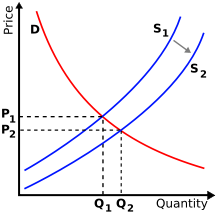
 What would compel otherwise rational decision makers to support such an illogical policy?  In a nutshell, it's a lack of joined up thinking.  Why subsidise fossil fuel production?  To shift the supply curve out to the right - increasing supply, reducing price, or both, as seen below:

Why do we need to increase supply?  Because we are consuming increasing quantities of fossil fuels.  Why are we consuming so much? Because we are not using renewables.  Because our buildings are inefficient, and we travel long distances in inefficient vehicles, and we manufacture large quantities of products in inefficient factories.

Why subsidise fossil fuel consumption? Because otherwise influential voters would revolt, poorer members of society would face fuel poverty, and manufacturers would threaten to take jobs elsewhere. Why are voters, households and employers sensitive to the price of fuel? Because their homes, vehicles and buildings use energy inefficiently and because they do not generate much, if any, of their own local power.

In other words, when confronted with the challenge of people using energy wastefully and failing to use locally available renewables, national leaders have responded with subsidies that boost production and lower the price of fossil fuels!  You can see how policy makers might find this response rational on a case-by-case basis, but from a broader systems perspective the case for these subsidies becomes ludicrous.  This "solution" becomes even more appalling when one considers the environmental cost.

A "big-picture" systems view can tackle these challenges simultaneously from an economy-wide and a local level.  If it is too expensive to drive vehicles long distances when people must face the full cost of fuel, then we can find ways to reduce vehicle miles per person or per tonne of goods: putting homes or factories closer to offices, increasing fuel efficiency, and using mass transit to reduce the number of cars people need to own.  If fuel costs are making homes unaffordable and businesses uncompetitive, then we can find ways to get the same benefits with less fuel: switch to renewables, where the "fuel" (sunlight, wind, etc) is free; or improve building and appliance efficiency so less energy is wasted.

#EndFossilFuelSubsidies is a clever campaign, but we need more systems-level thinking if it is to become more than a slogan that disappears after 24 hours.